The Wren: Why the UK’s Loudest Tiny Bird is the Real “King of Birds

If you stand in a British woodland—or even just a quiet corner of your garden—and close your eyes, there is one sound that eventually cuts through everything else.
It isn’t the melodic warble of a Blackbird or the repetitive “teacher-teacher” of a Great Tit.
It is a rapid-fire rattle, a trill so loud, explosive, and machine-gun fast that it feels like it should belong to a bird ten times the size. It dominates the soundscape, demanding your attention.
But when you open your eyes to look for the singer, you’ll be lucky to spot him.
It’s the Wren (Troglodytes troglodytes).
For me, the wren is the unsung hero of the British countryside. It is technically our commonest breeding bird (with over 11 million pairs), yet we rarely get a good look at it.
It’s a tiny, round ball of energy, flitting through the undergrowth like a clockwork mouse, tail cocked aggressively in the air.
Don’t let that cute appearance fool you, though. The wren is a survivor, a Casanova, a physics-defying singer, and—according to ancient legend—the true King of the Birds.
The “Cave Dweller”
First, let’s talk about that scientific name: Troglodytes troglodytes. It might sound like an insult, or perhaps a dinosaur name, but it is actually a perfect description of the bird’s character. It translates from Ancient Greek as “Cave Dweller.”
Wrens don’t act like other garden birds. They don’t soar in the open sky or hop boldly on the lawn like a Robin.
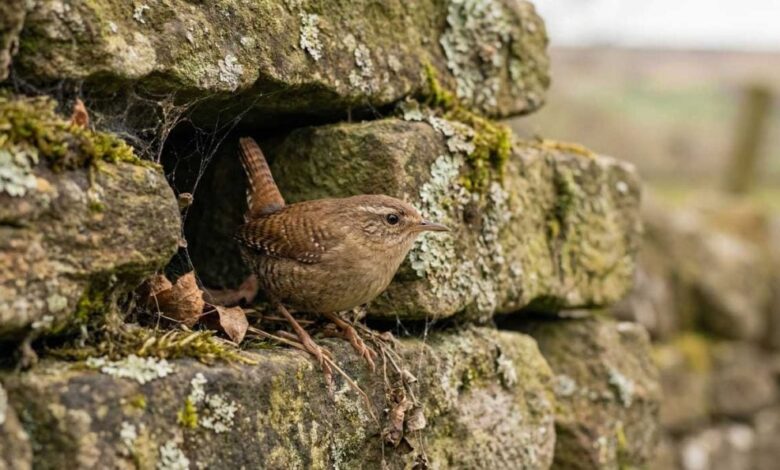
They creep. They scuttle into dark crevices, under log piles, and into the deepest shadows of the ivy. I’ve watched them vanish into dry stone walls in the Yorkshire Dales and reappear five metres further down, having navigated a hidden tunnel network that only they know.

This behaviour is why they are often described as “mouse-like.” If you see a small brown shape scuttling through the dead bracken at speed, it’s almost certainly a wren.
A Voice Like a Jet Engine
The most mind-blowing fact about the wren is its volume.
Weighing in at just 8 to 10 grams (roughly the same as a £1 coin), the wren can produce a song that hits 90 decibels.

To put that in perspective, 90dB is roughly as loud as a lawnmower running right next to you, or a shouted conversation.
How does something so small make a noise that big?
It is a feat of biological engineering. Birds don’t have a larynx like mammals; they have a syrinx located deep in their chest where the windpipe splits into the lungs.
The wren has very specialized, powerful muscles wrapped around this organ. When it sings, it essentially turns its entire body into a resonating chamber, trembling with the effort.
Pound for pound, a wren is ten times louder than a cockerel. It is the Pavarotti of the hedgerow.

The “Bachelor Pad” Strategy
If you think modern dating is hard, spare a thought for the male wren. His breeding strategy is exhausting and architectural.
In early spring, the male doesn’t just build one nest to impress a female. He builds six to twelve. These are called “cock nests”—rough, domed structures made of moss, leaves, and grass, tucked into banks, ivy, or tree hollows.
When a female enters his territory, he gives her the grand tour. She inspects his handiwork, checking the location and construction. If she’s unimpressed? She leaves, and he has to start again or try to attract another female.
If she likes one, she moves in and lines it with soft feathers to make it ready for eggs.
Because he has so much real estate, a successful male is often polygamous, having active nests with two or three females at the same time in his territory.
But the catch is that he has to defend this massive patch against rivals, singing his heart out from dawn till dusk to keep intruders away.
The Winter Huddle: A Survival Miracle
Despite their feisty nature, wrens are surprisingly vulnerable. Because they are so tiny, they have a massive surface-area-to-volume ratio, meaning they lose body heat incredibly fast.
A harsh, freezing British winter can wipe out huge numbers of them—sometimes up to 25% of the population.
To survive, they do something adorable. They put aside their intense territorial aggression and huddle.
On freezing winter nights, wrens will gather and pile into a single nesting box or cavity to share body heat.
They pack themselves in like sardines, heads facing inwards, tails out, creating a singular ball of warmth.
The record for this is staggering: in 1969, a birdwatcher in Norfolk counted 61 wrens emerging from a single wooden nest box one morning!

The St Kilda Wren: The “Super-Wren”
If you travel to the very edge of the UK, to the remote archipelago of St Kilda, you will find a wren that is different from all others.
Cut off from the mainland for thousands of years, the wrens here have evolved into a distinct subspecies (Troglodytes troglodytes hirtensis).
They are larger, heavier, and louder than their mainland cousins. Because there are no trees on the windswept islands of St Kilda, these wrens have adapted to nest in the cliffs, scavenging for insects among the puffin burrows and seabird colonies.
It is a brilliant example of evolution in action, creating a “Super Wren” capable of surviving Atlantic storms.

Folklore: The King of All Birds
With such a big personality, it’s no surprise the wren is steeped in folklore. Across Europe, the wren is known as the “King of Birds.”
The fable tells of a great competition to decide who should be King.
It was decided that whoever could fly the highest would win the crown. The Eagle, naturally, soared above everyone else, confident of victory. But just as the Eagle began to tire and descend, the tiny Wren—who had hidden quietly in the Eagle’s feathers—popped out and flew just a few inches higher, claiming the title.
It’s a story of brains over brawn. While the Eagle was furious (which is why the wren hides in hedges to avoid him!), the title stuck.
The Darker Side: Wren Day
In Ireland and the Isle of Man, this title led to a darker tradition. St Stephen’s Day (26th December) is known as “Wren Day.”
Historically, “Wren Boys” would hunt a wren and parade it around the village on a pole, singing songs to collect money.
Thankfully, in modern times, this tradition has evolved. The “Hunt” is now symbolic, with a fake bird used, but the songs and the celebration of the “King of all Birds” remain a key part of the winter festivities.
Photography Tips: Capturing the Bullet
Photographing a wren is one of the ultimate challenges for a wildlife photographer. They are fast, small, and stick to the shadows.
- Listen First: You will hear a wren before you see it. Listen for the machine-gun rattle alarm call or the loud song. Locate the bush the sound is coming from.
- The “Singing Perch”: When a male is declaring territory, he will often pop up to the very top of a bramble or gorse bush to sing. He will usually use the same few perches repeatedly. Focus your camera on the top of that perch and wait.
- Fast Shutter: Wrens don’t sit still. You need a shutter speed of at least 1/2000s to freeze their twitchy movements.
- Get Low: Wrens are ground-dwellers. Photos taken looking down on them rarely look good. Get down on your knees (or belly) to shoot at eye level. This creates a nice blurry background (bokeh) and makes the bird look bold and imposing.
How to Help Them
Wrens are insect hunters. They are looking for spiders, beetles, and moths hidden in the dark corners of your garden.
- The Log Pile: The best thing you can do is leave a pile of logs or sticks in a damp corner. This attracts the insects wrens eat and provides the “caves” they love to explore.
- Ground Feeding: They won’t use hanging feeders. Scatter mealworms or cheese (mild, grated) under the cover of a bush. They love it, but they need to feel safe from cats while they eat.
- Leave the Ivy: Ivy is a wren’s best friend. It provides nesting sites, winter shelter, and a buffet of hibernating insects. If you have ivy on a wall or tree, let it be.
So, next time you hear that explosive song in the garden, take a moment to look for him. He might be small, but the wren is a giant character in a tiny package.
If you want to look after and feed birds and animals like the wren in your garden then check out The Ultimate Guide to Feeding Garden Wildlife in the UK
Source link