27th Constitutional Amend clears Senate amid ‘uproar, defections and deepening political rifts’

- Govt pushes 27th Amendment through Senate with an emphatic 64-vote majority, securing crucial two-thirds support
- Bill set for NA tabling today after stormy Senate approval sparks nationwide debate
- Treasury–opposition clashes trigger chaos as lawmakers trade slogans, accusations
- PPP’s Ashraf defends presidential immunity; PTI benches respond with uproar
- Committees clear amendment with ‘minor tweaks’ amid opposition boycott
- Two opposition defections secure crucial two-thirds majority in Upper House
- ANP, MQM proposals deferred; govt vows broader consultation with provinces
- Walkouts, torn bill copies mark Senate spectacle before smooth final vote
- Dar says Article 243 changes ‘amicably settled’ as debate over civil-military balance intensifies
ISLAMABAD: The government on Monday pushed the contentious 27th Constitutional Amendment through the Senate with an emphatic 64-vote majority, securing the crucial two-thirds support it needed after weeks of political turbulence, fierce objections from the opposition and acrimonious scenes inside the upper house.
The amendment — one of the most consequential constitutional overhauls in recent years — passed after dramatic procedural voting, loud sloganeering, torn copies of the bill hurled towards the treasury benches, and a walkout by nearly the entire opposition, which accused the government of forcing through a measure that would reshape Pakistan’s judicial and military command structures without national consensus.
The ruling coalition’s victory hinged on the defection of two opposition senators, allowing the amendment to comfortably cross the 64-vote threshold required in the 100-member house. The government now moves to the final stage: securing passage in the National Assembly, where it already enjoys a two-thirds majority.
Yet Monday’s proceedings — charged, chaotic and politically revealing — also exposed widening cracks in several political parties, signalled intra-party dissent, and raised questions about the long-term implications of new constitutional arrangements, including the creation of a Federal Constitutional Court, alterations to Article 243, and the formal constitutional recognition of a five-star field marshal rank.
Opposition protests, torn papers and walkout clear the way
The Senate session, presided over by Chairman Syed Yousaf Raza Gilani, witnessed heated scenes even before Law Minister Azam Nazeer Tarar rose to present the bill.
Opposition lawmakers rose from their seats shouting slogans, accusing the government of upending constitutional traditions, and casting the amendment as an assault on the judiciary and an attempt to shield specific offices from accountability.
Several opposition members tore copies of the bill and flung them toward the law minister’s table.
The uproar, however, had the unintended effect of paving the way for the bill’s smooth passage. After sloganeering for several minutes, the opposition staged a walkout, with only a small number temporarily remaining in the chamber to continue protest chants before leaving.
With the chamber largely emptied of dissenting voices, the government easily completed the clause-by-clause voting and subsequently closed the gates for voting by division — completing what it had sought to achieve for weeks.
Committee approval, NA vote tomorrow
Earlier in the day, a joint meeting of the Senate and National Assembly standing committees on law and justice — boycotted by the opposition — voted to approve the bill with minor changes. The changes were incorporated into a detailed report presented by Senator Farooq H. Naek, chairman of the Senate’s Law and Justice Committee.
With Senate approval secured, the government now requires passage by the 336-member National Assembly, where the ruling coalition holds 233 seats, comfortably exceeding the two-thirds requirement. The NA, which briefly met today but was adjourned amid noisy exchanges, will reconvene at 11am Tuesday.
The coalition’s numbers in the lower house include PML-N (125 seats), PPP (74), MQM-P (22), PML-Q (5), IPP (4), and one seat each for three smaller coalition partners.
Political tremors: PTI senator resigns after voting ‘for Gen Asim Munir’
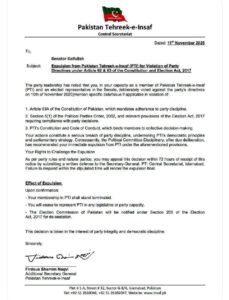
In one of the day’s most striking developments, PTI Senator Saifullah Abro dramatically resigned from the Senate moments after voting in favour of the amendment.
Taking the floor shortly after the vote, Abro said he had cast his ballot “only for Syed Gen Asim Munir”, adding:
“The Pakistani armed forces made the nation proud by winning the war with India. During the 26th Amendment, 10 family members of mine were abducted, but my party did not come to the rescue.”
His remarks triggered gasps in the chamber and signaled deep internal dissent within PTI ranks.
Senate Chairman Gilani responded reassuringly:
“We will make you a senator again.”
Separately, JUI-F expelled its senator Ahmed Khan for voting in favour of the bill in defiance of party instructions.
جمعیت علمائے اسلام پاکستان نے پارٹی ڈسپلن کی خلاف ورزی کرتے ہوئے 27ویں آئینی ترمیم کے حق میں حکومتی بل کو سپورٹ کرنے پر سینیٹر احمد خان کو پارٹی سے خارج کر دیا ہے۔ pic.twitter.com/1Dr5kH1KPA
— Jamiat Ulama-e-Islam Pakistan (@juipakofficial) November 10, 2025
Government: Amendment is ‘historic’, fulfils Charter of Democracy
Deputy Prime Minister and Foreign Minister Ishaq Dar, speaking immediately after the bill’s approval, hailed the amendment as “historic” and part of the “unfinished agenda” of the 2006 Charter of Democracy (CoD).
Dar said the amendment would bring long-needed structural clarity:
“There was a feeling to maintain balance, and thus a constitutional court is being formed for the betterment of the judiciary.”
On the controversial clause creating constitutional space for the field marshal rank, Dar argued:
“Space has been created for a five-star general across all three military forces. The seniority of current Supreme Court judges or the chief justice will not be affected.”
Key changes finalised by parliamentary committee
Tabling the committee report, Senator Farooq Naek outlined several adjustments:
- Establishment of Federal Constitutional Court (FCC)
The committee unanimously approved the creation of the FCC but added key revisions:
All provinces will have equal representation.
Islamabad High Court will also have representation.
- Appointment criteria revised
Original requirement: 7 years of service as a high court judge.
Revised requirement: 5 years.
- Seniority rules
Sitting SC judges appointed to the FCC will retain their inter-se seniority.
For fresh appointments, seniority starts from oath date.
If multiple judges take oath on same day, age determines seniority.
- JCP composition adjusted
The committee replaced the earlier provision for a woman or non-Muslim nominee with a more flexible option:
The Speaker may nominate a woman, non-Muslim, or technocrat qualified to be an MP.
- Suo motu powers defined
FCC retains suo motu powers.
Cases will proceed only after the court determines the validity and necessity of the application.
- Judges’ transfer mechanism changed
Transfers will now occur through the Judicial Commission of Pakistan, ensuring representation from the executive, parliament, civil society, and bar.
- Interim stay orders under Article 199
Stay orders in revenue matters will expire automatically after one year unless decided.
Senate debate highlights deep division
Throughout the day, senators from across the political spectrum delivered fiery speeches encapsulating Pakistan’s widening political and institutional rifts.
PML-N’s Agha Shahzaib Durrani
Criticised opposition objections to the FCC.
Accused PTI of “turning the President’s House into an ordinance factory.”
PPP’s Zamir Hussain Ghumro
Ghumro defended the amendment and sharply criticised the Supreme Court:
“The SC has not performed its original function. It has been interfering in Parliament and the executive.”
Referring to Article 243 and India’s recent aggression, he said:
“The field marshal won a war for Pakistan. Should a hero be dragged through courts?”
PTI’s Fawzia Arshad
Arshad raised procedural objections, pointing out that there was no notified opposition leader in the Senate since the disqualification of Shibli Faraz:
“Institutions are being trampled and their rights taken away.”
MQM-P’s Amir Waliuddin Chishti
Chishti expressed disappointment that MQM-P’s proposals on Articles 140-A and 142 were not incorporated, raising concerns over possible delays.
PML-N’s Khalil Tahir Sindhu
Sindhu dismissed criticism of the field marshal clause, noting that many Commonwealth countries retained lifetime military ranks.
Opposition vows to block amendment in NA
Outside the chamber, PTI Senator Ali Zafar warned that the government would be unable to pass the bill in the NA if it lacked the necessary numbers:
“We are against giving immunity from criminal proceedings to anyone — president or governor. If someone has committed a crime, they should be punished.”
Information Minister Ataullah Tarar, however, defended presidential immunity:
“Heads of state enjoy immunity across the world. The Constitution is a living document; it evolves.”
He stressed the amendment strengthened good governance, federal-provincial relations, and defence.
MQM-P supports Article 243 changes, renews LG autonomy demand
MQM-P parliamentary leader Faisal Subzwari echoed concerns about Pakistan’s external security challenges:
“With India’s military might on the eastern front and a dispute on the western front, we must support our armed forces.”
He also pushed strongly for local government empowerment, arguing it would enhance service delivery:
“This is not a rollback of the 18th Amendment. It is to ensure citizens receive resources meant for them.”
Low attendance at Dar’s ‘constitutional breakfast’
Ahead of the crucial vote, Deputy PM Ishaq Dar hosted a breakfast to rally lawmakers.
Only 24 senators attended, far fewer than expected.
Senator Danesh Kumar, however, reassured reporters:
“I broke bread at the breakfast and will stay with the government.”
JUI-F announces it will not support amendment
JUI-F chief Maulana Fazlur Rehman, departing for an international conference in Bangladesh, declared:
“JUI-F will not vote in favour of the 27th Constitutional Amendment. The government violated its commitment by reintroducing points removed from the 26th Amendment.”
A day of power plays, defections and high stakes
Monday’s Senate session marked a decisive step in the government’s constitutional reform push — but also showcased the deep fractures that define Pakistan’s political landscape today.
While the government is poised to secure swift passage in the National Assembly, the controversy surrounding the amendment — from judicial restructuring to military command provisions and presidential immunity — ensures that the debate will continue to dominate political discourse for weeks to come.
The amendment’s fate may now be assured, but the political scars left behind after its contentious Senate journey are likely to shape future parliamentary relations, party cohesion, and Pakistan’s evolving institutional landscape.