Stepping Into the Storybook: A Visit to Beatrix Potter’s Hill Top Farm

There are museums, there are historic houses, and then there is Hill Top.
Walking up the garden path in Near Sawrey, I had a sudden, strange sensation that I wasn’t just visiting an old farmhouse; I was walking directly into the pages of a book I’d known since childhood. And in a way, I was.
Hill Top isn’t just the place where Beatrix Potter lived; it’s the place she drew. It is the literal, physical bricks-and-mortar setting for The Tale of Samuel Whiskers, The Tale of Tom Kitten, and The Tale of Pigling Bland.
When she left it to the National Trust, she didn’t just leave a building; she left a time capsule, stipulating that it be kept exactly as if she had “just stepped out for a walk.”
I’ve visited many literary homes, but this one is different. It feels chaotic, cluttered, and wonderfully alive.

Here is the story of my visit, the secrets I found hidden in the walls, and everything you need to know to plan your own pilgrimage to the home of Peter Rabbit’s creator.
The Garden: Where Tom Kitten Lost His Clothes
Before you even reach the front door, the magic starts.
The garden at Hill Top is a glorious, haphazard cottage jungle—a mix of foxgloves, sweet williams, and veggies that looks delightfully messy but is actually curated with forensic precision to match Beatrix’s 1907 illustrations.

I found myself standing at the white wicket gate at the bottom of the path and realized I was looking at the exact spot where Tom Kitten and his sisters, Moppet and Mittens, climbed up and famously lost their clothes to the Puddle-Ducks.

The National Trust gardeners ensure the view matches the book perfectly, right down to the slate walls and the flowers blooming in the borders.
Look out for:
- The Rhubarb Patch: Just to the side of the path. This is the very spot where the naive Jemima Puddle-Duck tried to hide her egg, aided by the “foxy-whiskered gentleman.”
- The Beehives: You’ll see the white hives tucked away, just as they appear in the tales.

Inside the “Firehouse”: Enter Samuel Whiskers
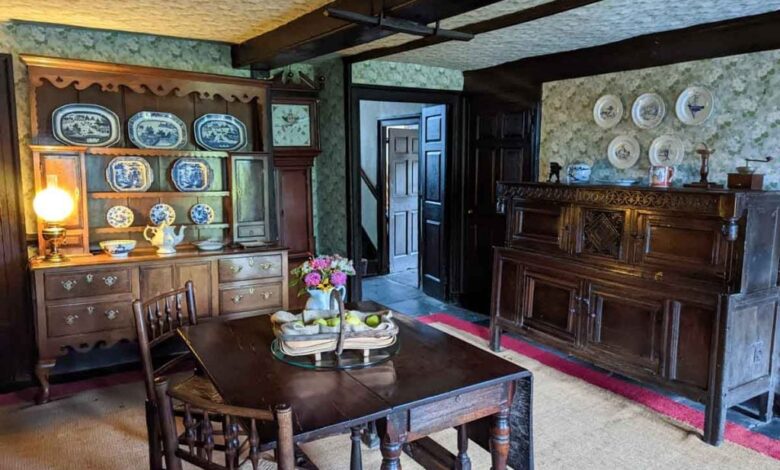
Stepping through the porch (which features in The Tale of Samuel Whiskers when Ruby the cat comes to borrow yeast), you enter the Entrance Hall, or what Lakeland farmers call the “firehouse.”
It’s dark, atmospheric, and smells faintly of old stone and history. The first thing that hits you is the recognition.

- The Range: The massive black iron range is the one that terrified Tom Kitten. You can practically see him looking up the chimney where the rats forced him.
- The Dresser: To the left stands a dresser laden with blue-and-white willow pattern china. Look closely at the illustration in Samuel Whiskers where Anna Maria the rat runs past with a stolen plate of dough—it is this dresser.

The Staircase and the “Roly-Poly” View
For me, the shivers really started at the staircase. It’s the central artery of the house. I stood at the bottom, looking up the white banisters with their dark handrail, and it was an exact match for the drawing of Tabitha Twitchit searching for her kittens.
But the best view is from the top landing. If you look back down into the hall, you are seeing the “Roly-Poly” view, where the rats rolled the unfortunate Tom Kitten in dough to make a pudding.
The wide, uneven oak floorboards creak underfoot, and the light filters through the window exactly as Beatrix captured it a century ago.

The Treasure Room: Ham, Marbles, and Mysteries
Upstairs, you’ll find the “Treasure Room.” This small space is where the “quirky” side of Beatrix Potter—or Mrs. Heelis, as she was known here—really shines. It’s filled with her “small things.”

The Tale of the Stolen Ham
The centrepiece is the Dolls’ House. This isn’t just any toy; it’s the inspiration for The Tale of Two Bad Mice. Inside, I spotted the tiny plaster ham and the red lobster.

In the story, the mice (Tom Thumb and Hunca Munca) fly into a rage when they discover the food is fake and plaster, smashing it up. Seeing the real plaster ham—which Beatrix described as looking like it would “cause indigestion”—was a delightful detail.
The 13 Marbles
Tucked away in a cabinet, I found a collection of 13 humble stone marbles. They aren’t fancy, but their story is fascinating.
Beatrix found them inside the walls of the house while renovating in 1905—lost toys from children who lived there centuries before her. She kept them as a little nod to the house’s past lives.
The “Rat’s Nest”
This is the wildest thing I learned. We tend to think of the stories as cute fiction, but The Tale of Samuel Whiskers was based on a very real infestation.
Beatrix wrote about the rats swarming the place. During later renovations, workers actually found a massive “rat’s nest” under the floorboards—a mix of paper, fabric, and bones—proving that Samuel Whiskers and his clan were very real tenants!
A House Full of Drawing Scenes
There are so many other scenes wherever you look that you can see are captured in her books and drawings.

Another great example is the chest of drawers you will find in the house:

This is used in an illustration for The Tale of Tom Kitten where Mrs Tabitha takes out all kinds of elegant and uncomfortable clothes.

Mrs. Heelis: The Farmer, Not Just the Writer
One thing that really comes across is that this wasn’t just a writer’s studio; it was a farmhouse.
In the “New Room” (her library), you see the desk where she managed her estate.
Keep an eye out for her clogs. There’s a pair of sturdy, wooden-soled shoes that remind you that the woman who painted delicate watercolours also spent her days tramping through mud, judging Herdwick sheep, and saving thousands of acres of the Lake District from development.

The Bedroom
In the bedroom you can see her bed that is a sight to behold in itself, dating from the 1600s. The wallpaper a striking green from a William Morris design.
On the bedroom fireplace you can see where her husband, William Heelis, carved their initials.

Planning Your Visit: The “Golden Rules”
Hill Top is small, fragile, and incredibly popular. It’s not a place you can just turn up to on a whim anymore, unless arriving on foot. Here is what you absolutely need to know to make your visit work.
1. The Winter Closure (Crucial!)
If you are reading this in late in the year, note that Hill Top is currently closed for its annual winter conservation. This “winter slumber” usually runs from November through to mid-February or March.
- Current Status: Closed (Nov/Dec 2025).
- Reopening: Expected March 2026 (Check the National Trust website for the exact date).
2. You Must Book Ahead
I cannot stress this enough: Pre-booking is mandatory if travelling by car. Tickets are released in batches on Thursdays, usually two weeks in advance. They sell out fast.
- Do not rely on getting a walk-up ticket; you will likely be turned away.
- Even National Trust members need to book a (free) timed slot.
I had the luxury of staying just around the corner at the lovely Ees Wyke Country House, Near Sawrey
3. Parking is Tiny
The car park has space for maybe 30 cars. If you don’t have a booked slot, you won’t get in.
- Top Tip: Leave the car behind. Take the Windermere Ferry from Bowness to the west shore, then hop on the Mountain Goat 525 bus. It drops you right at the door, and it’s a much more relaxing way to arrive (plus, the ferry ride is beautiful!).

4. No Loos in the House
It’s a 17th-century farmhouse. There are no toilets inside. Make sure you use the facilities in the car park/ticket office area before you head up the garden path!
5. Look for the “Mischief”
If you are visiting during the main season, keep your eyes peeled for the “Mischief in Miniature” exhibition.
The curators hide tiny felted mice (Hunca Munca and friends) in the nooks and crannies of the house.
It’s a great way to keep kids engaged and forces you to look into the dark corners you might otherwise miss.
Hill Top is a rare gem. It’s a place where the line between fiction and reality completely dissolves.
Whether you’re there for the literary history or just to see a perfectly preserved slice of Lakeland life, it is a memory that sticks with you. Just remember to book that ticket!
If you want to take a short walk and climb from Hilltop Farm you can find a glorious little lake nearby where William and Beatrix spent lots of time together on and by the water: Moss Eccles Tarn, A Walk From Near Sawrey
And you are not far from Hawkshead and Tarn Hows to get plenty more Beatrix Potter inspiration.
The Lake District is packed more than you think with connections to Beatrix Potter. Even the valley as far as beside Catbells was an inspiration for her books and illustrations.
Source link


