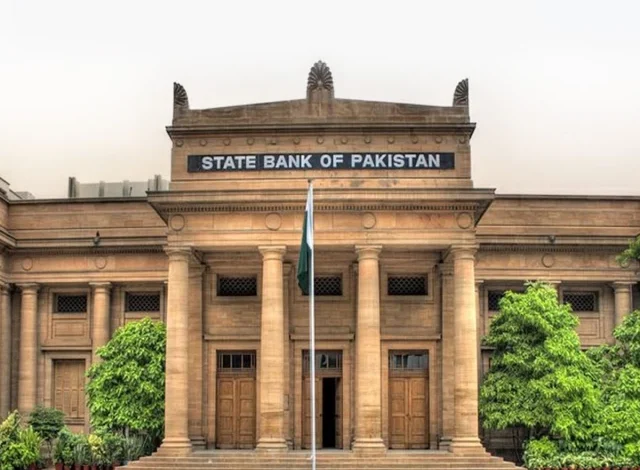
State Bank of Pakistan. Photo: File
KARACHI:
The State Bank of Pakistan (SBP) on Monday reduced the policy rate by 50 basis points to support sustainable economic growth, delivering a surprise to markets and marking a move that diverged from the International Monetary Fund’s (IMF) more cautious stance, which had emphasised maintaining the policy rate.
Announcing its decision after the Monetary Policy Committee (MPC) meeting, the central bank said headline inflation had remained within the target range of 5-7% during JulyNovember FY26, creating limited space for calibrated monetary easing. The MPC, however, acknowledged that core inflation remained relatively sticky and required continued vigilance. It stressed that the rate cut was aimed at reinforcing the ongoing recovery in economic activity without undermining price stability.
The decision came at a time when most market participants had expected the SBP to maintain the policy rate, reflecting concerns over inflation risks, external account pressures and the IMF’s repeated calls for caution. The IMF, following the completion of the Extended Fund Facility (EFF) and Resilience and Sustainability Facility (RSF) reviews, had underlined the importance of maintaining an “appropriately tight” monetary stance and ensuring that real interest rates remain positive on a forward-looking basis. Against this backdrop, the SBP’s move was widely viewed as a calculated deviation rather than a wholesale shift in policy direction.
According to the MPC, economic activity has continued to gain traction, supported by robust improvements in key high-frequency indicators. Large-scale manufacturing (LSM) recorded 4.1% year-on-year growth in Q1-FY26, with broad-based increases across most sectors. Rising sales of automobiles, fertiliser and cement, along with higher imports of machinery and intermediate goods, pointed to strengthening industrial momentum. The central bank argued that easing financial conditions would help consolidate these gains and support investment.
Developments in the agricultural sector also reinforced the MPC’s relatively optimistic outlook. Data on wheat sowing, input availability and government-backed incentive schemesprogrammes suggested that wheat production could surpass official targets, supporting rural incomes and food supply. Improved performance in agriculture and industry is expected to spill over into the services sector, prompting the SBP to maintain its projection that real GDP growth in FY26 would remain in the upper half of the 3.25-4.25% range.
On the external front, the MPC noted that the current account deficit stood at $0.7 billion during JulyOctober FY26, broadly in line with expectations. Imports expanded in tandem with rising economic activity, while workers’ remittances remained resilient. Exports, however, came under pressure due to a sharp decline in food exports, particularly rice, reflecting both global and domestic challenges. Despite tepid net inflows, SBP’s foreign exchange reserves rose above $15.8 billion, aided by continued central bank purchases and the receipt of about $1.2 billion from the IMF.
Looking ahead, the central bank acknowledged that the global environment remained challenging, particularly for exports, amid evolving trade dynamics and tight international financial conditions. Nevertheless, lower global oil prices were expected to help contain the import bill. Overall, the SBP maintained its assessment that the current account deficit would remain within 01% of GDP in FY26, with foreign exchange reserves projected to strengthen further to around $17.8 billion by June 2026, subject to the realisation of planned official inflows.
Fiscal developments presented a mixed picture. In Q1-FY26, both overall and primary fiscal balances recorded surpluses, largely due to a sizeable transfer of profits from the SBP and restrained expenditures. However, the MPC expressed concern over the slowdown in Federal Board of Revenue (FBR) tax collection growth, which eased to 10.2% year-on-year during July-November FY26. This slowdown implies a significant acceleration will be required in the remaining months to meet annual targets. While lower-than-budgeted interest payments may help contain the fiscal deficit, achieving the targeted primary surplus remains challenging.
In this context, the MPC underscored the importance of structural reforms, echoing key IMF priorities. It highlighted the need to broaden the tax base, rationalise expenditures and accelerate the privatisation or restructuring of loss-making state-owned enterprises (SOEs) to strengthen fiscal buffers and create space for public investment and social spending.
Monetary and credit indicators suggested that easing financial conditions were already feeding into borrowing activity. Broad money (M2) growth accelerated to 14.9% by late November, driven mainly by increased government borrowing from the banking system. Private sector credit expanded by Rs187 billion only during JulyNovember, with strong demand from textiles, wholesale and retail trade, and chemicals. Consumer financing, particularly auto loans, also remained robust.
On inflation, the MPC noted that headline inflation had remained within the target range for the past three months, with food, energy and core components gradually converging. However, the central bank cautioned that inflation could rise temporarily above the target range toward the end of FY26 due to base effects and potential supply-side shocks, before easing back in FY27.
Source link