There are certain flowers that don’t just mark a change in the weather; they mark a change in our mood. The Primrose (Primula vulgaris) is exactly that kind of flower.
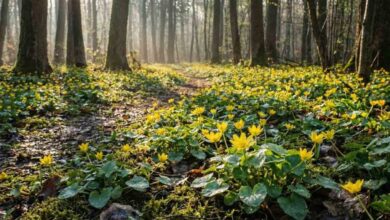
After the white of the Snowdrops and the Wood Anemones, the arrival of the Primrose brings the first wash of true colour to the British hedgerows.
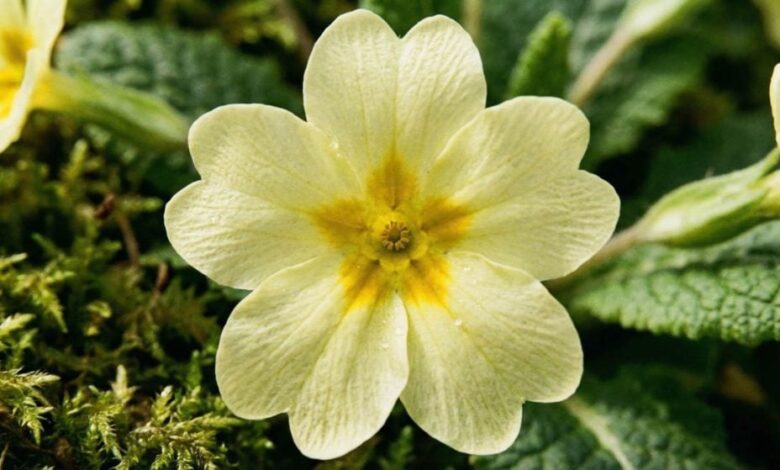
But it isn’t a shouty, aggressive yellow like the Dandelion. It is a soft, buttery, custard-yellow that seems to glow gently against the mossy banks.
Its name tells you everything you need to know. It comes from the Latin prima rosa, meaning “first rose.”
Now, botanically speaking, it isn’t a rose at all—it’s a member of the Primulaceae family. But to our ancestors, looking out at a bleak landscape, this beautiful bloom was the “first rose” of the new year, a symbol that life was returning.

The “Pale” Flower of Shakespeare
If you look closely at a wild Primrose, you’ll see why it has captured the imagination of poets for centuries.
The flowers grow on individual stems (unlike its cousin the Cowslip, which has a cluster of flowers at the top of a stalk).
The leaves are crinkled and textured, like the skin of a Savoy cabbage, tapering softly down to the base.
Shakespeare was seemingly obsessed with them. He mentions them in Hamlet, A Midsummer Night’s Dream, and The Winter’s Tale. In Hamlet, he gave us the famous phrase “the primrose path of dalliance,” referring to a life of easy pleasure and indulgence.
But he often described them as “pale.”
In Cymbeline, he writes of the “pale primrose.”. This perfectly captures that unique shade of yellow—so distinct from the garish, bright hybrids (Polyanthus) you see in garden centres today.
The wild Primrose has a subtlety that cultivation just can’t match.
Pin-Eyed or Thrum-Eyed?
Here is a little challenge for your next walk. When you find a patch of Primroses, kneel down and look right into the centre of the flowers. You will notice there are two different types.
Pin-eyed: You can see a little green pin-head (the stigma) sticking up in the middle, looking like a pin.
Thrum-eyed: You can’t see the pin, but you can see a cluster of yellow anthers (the pollen-bearing bits) blocking the throat of the flower.

This isn’t an accident. It’s a clever evolutionary trick to ensure cross-pollination.
An insect visiting a “Pin-eyed” flower gets pollen on its head, which is exactly the right height to brush against the stigma of a “Thrum-eyed” flower, and vice-versa. Even Charles Darwin was fascinated by this mechanism!
Bad Luck for Chickens?
For such a cheerful flower, the Primrose comes with a surprising amount of superstitious baggage, particularly if you keep chickens.
In English folklore, it was considered incredibly bad luck to bring a small number of Primroses into the house—specifically, anything less than thirteen.
The belief was that the number of Primroses you brought inside would determine the number of chicks your hens would hatch that year. Bring in just one flower? You’ll only get one chick.
Worse still, in some parts of the West Country, bringing a single Primrose into a house was thought to cause death or illness to a family member.
So, if you are going to pick them (though I prefer to leave them for the bees), make sure you pick a massive bunch!
The Flower of Parliament
The Primrose also has a strange place in political history. It was the favourite flower of the Victorian Prime Minister Benjamin Disraeli.
When he died in 1881, Queen Victoria sent a wreath of Primroses to his funeral with a handwritten note: “His favourite flowers: from Osborne: a tribute of affectionate regard from Queen Victoria”.
This sparked a movement. The anniversary of his death, April 19th, became known as “Primrose Day.”

For decades afterwards, Conservative supporters would wear Primroses in their buttonholes, and the statue of Disraeli in Parliament Square would be decorated with great garlands of them.
It’s a tradition that has mostly faded now, but for a time, this humble woodland flower was a powerful political symbol.
A Feast for Fairies (and Humans)
If you believe the old Celtic legends, eating a Primrose is the key to seeing fairies. It was said that if you ate the flowers, you would be granted the power to see the “Little Folk”.
If you aren’t hunting for fairies, you can still eat them. The flowers are edible and have a faint, sweet scent.
In the past, they were crystallized with sugar to decorate cakes, or boiled down to make Primrose wine or tea, which was thought to be a remedy for rheumatism and insomnia.
A Lifeline for Spring Wildlife
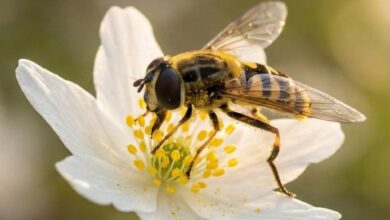
While we admire them for their history and beauty, for the insect world, they are a matter of survival.
Appearing as early as December in mild years, but peaking in March and April, they provide essential nectar for early pollinators.
Look out for the Brimstone butterfly—that distinctively yellow butterfly that looks like a flying leaf. It is often one of the first butterflies to emerge from hibernation, and the Primrose is one of its favourite refuelling stops.

So, when you see that flash of pale yellow on the roadside bank, take a moment to appreciate it. It’s a political badge, a fairy portal, a biological marvel, and the true “first rose” of the British spring.
Source link