PM Shehbaz confirms several countries in ‘active talks’ for JF-17 fighter jets

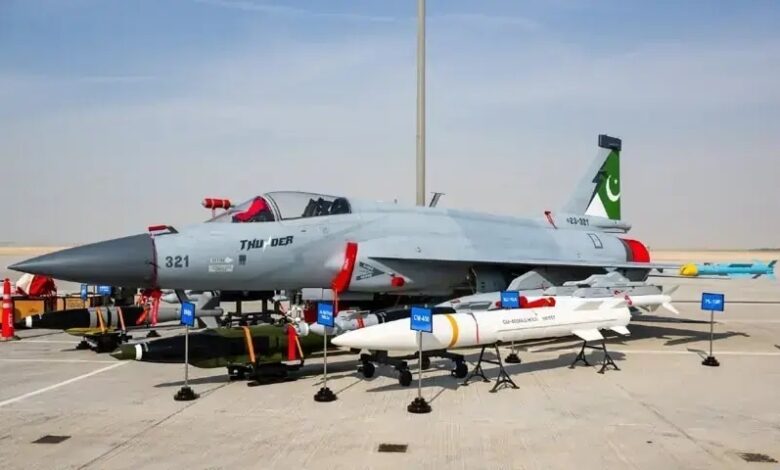
- Premier Shehbaz says global demand rose Pakistani fighter jets after May 2025 conflict
- State Minister for defence production says several countries engaged in talks for JF-17 Thunder jointly developed with China and produced locally
- Emphasizes Pakistan would only export JF-17 to friendly countries to ensure aircraft were not used against its own interests
- Notes China remained fully involved in any such deal, given its role in the aircraft’s development
ISLAMABAD: Prime Minister Shehbaz Sharif on Wednesday confirmed that several countries were “actively” engaged in talks with Pakistan for the acquisition of its fighter jets, saying international demand had risen following Pakistan’s victory in a war last year—an apparent reference to the four-day military conflict with India in May 2025.
Addressing a meeting of the federal cabinet, the prime minister said that growing interest in Pakistan’s defence equipment would strengthen indigenous defence production and provide a boost to the national economy.
“There are several countries that are actively engaged in talks with Pakistan on this, and this will boost our defence production and benefit our economy,” PM Shehbaz said.
In recent weeks, reports have emerged indicating that Pakistan is in discussions with several friendly countries regarding the sale of the JF-17 Thunder, a light combat aircraft jointly developed by Pakistan and China and manufactured domestically.
Earlier, Defence Production Minister Raza Hayat Hiraj also told BBC Urdu that Pakistan was engaged in negotiations with “multiple” countries for the export of the JF-17 fighter jet.
“These negotiations are taking place and they take some time. Many countries have shown interest in these aircraft,” the minister said in an interview published on Tuesday.
He declined to disclose the names of the interested countries or the stage of the negotiations. “I cannot take the name of any country. Neither can I tell on what level our negotiations are with any country,” he said, adding that such matters were a country’s “jealously guarded secrets.”
“When these jets are exported, then the world will know which countries have bought them,” Hiraj added.
The minister emphasised that Pakistan would only export the JF-17 to friendly countries to ensure the aircraft were not used against its own interests. He also noted that China remained fully involved in any such deal, given its role in the aircraft’s development.
Hiraj highlighted that the JF-17 was battle-tested during last year’s four-day conflict with India, saying its performance was observed and praised by air forces around the world.
Describing pricing as a key factor behind international interest, the minister said that while fighter jets globally were typically valued between $250 million and $350 million, the JF-17 Thunder was significantly more affordable.
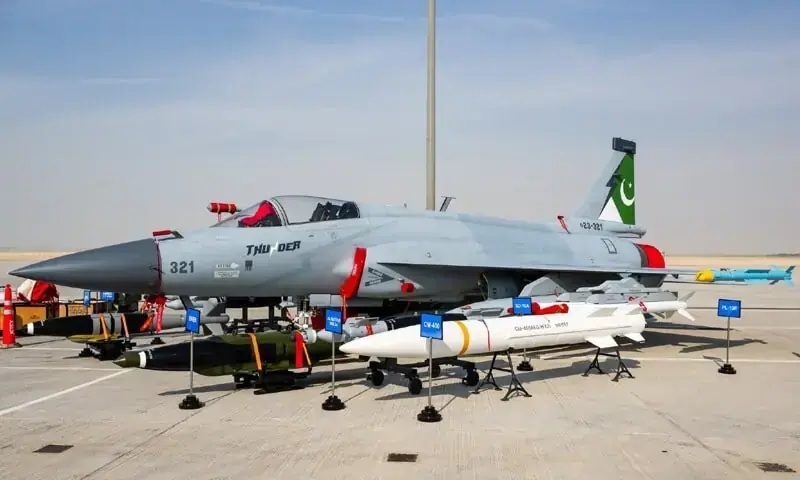
“Its value is around $40–50 million; this depends on the jet’s features, and the price can also be higher than this,” he said.
Asked whether China also received a share from the export of the aircraft, Harraj said that such matters were discussed as part of the agreements. “China is definitely included in them; it should be and it is their right,” he added.
‘Production capacity a secret’
Responding to a question on Pakistan’s production capacity amid growing international interest, the defence production minister declined to provide details, describing it as a matter of national security.
“This is a question related to our national defence. These are our secrets; let them remain secrets,” he said, while noting that the production of such state-of-the-art aircraft was a time-consuming process.
According to Harraj, certain components of the JF-17 are manufactured in Pakistan, while others are produced in China.
Einar Tangen, a senior fellow at China’s Centre for International Governance Innovation (CIGI), told BBC Urdu that the core technology of the aircraft was likely controlled by China, making any export agreement a joint arrangement with Beijing as a “senior partner.”
“China might even increase Pakistan’s defence production, but all this will be in Beijing’s control,” he was quoted as saying.
Earlier this month, the air chiefs of Pakistan and Bangladesh held detailed discussions on the potential procurement of JF-17 fighter jets.
Pakistan Air Force (PAF) Air Chief Marshal Zaheer Ahmed Babar Sidhu also visited Iraq this week, where he met his counterpart, who expressed “keen interest” in the aircraft.
Recently, Reuters, citing two Pakistani sources, reported that Islamabad and Riyadh were in talks to convert around $2 billion in Saudi loans into a JF-17 deal.
Indonesia’s Defence Minister Sjafrie Sjamsoeddin also visited Pakistan last week and held meetings with the army chief and the PAF air chief. According to the military’s media wing, the Indonesian minister expressed Jakarta’s desire to further expand defence ties with Islamabad.
Defence cooperation with KSA, Turkiye
According to BBC Urdu, Defence Production Minister Harraj refrained from sharing details of the Pak-Saudi defence agreement signed in September 2025.
“This is a defence agreement between the field marshal, the prime minister and the Saudi government. I cannot tell any more than this,” he said.
Last week, Bloomberg reported that Turkiye was seeking to join the pact.
“From a strategic point of view, Turkiye, China, Saudi Arabia and Azerbaijan are close friendly countries of Pakistan, and there is a close relationship with them in terms of strategic policy,” the report said.
Source link