If you follow my adventures, you’ll know that my life is rarely static. Between the boundless energy of Malc the Border Collie and the rugged endurance of Pete the German Wirehaired Pointer, our pack is built for the mountains.
But then, there was a dog that was so different, that travelled and hiked all over with me, that was Bea.
Bea represents a completely different side of the canine spectrum.

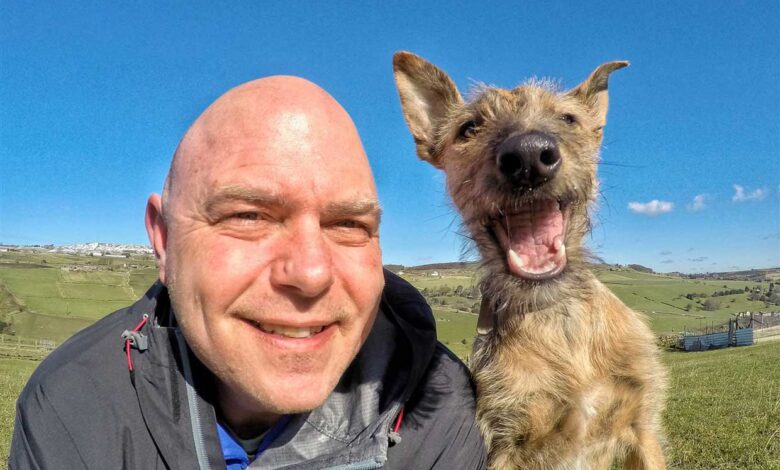
She is a Lurcher—specifically, a mix of Deerhound (50%), Greyhound (25%), and Saluki (25%). To look at her, she is a lanky, elegant creature who seems too fragile for the rough trails, but don’t let those looks deceive you.
Living with a Lurcher is a lesson in duality: they are the fastest dogs you will ever own, and yet, quite possibly, the laziest.

If you are considering bringing a Lurcher into your life, or just want to know more about the “poser” you see in my photos, here is what it is really like to live with a sighthound.

What Actually Is A Lurcher?
Unlike Pete (a recognised breed) or Malc, a “Lurcher” isn’t a breed in the strict Kennel Club sense; it is a type.
Historically, they were the “poacher’s dog”—a cross between a sighthound (for speed) and a working dog like a Collie or Terrier (for intelligence and hardiness).

Bea is technically a “Longdog”—a cross between two or more sighthound breeds—but in the hiking world, she fits firmly under the Lurcher umbrella. Her mix is fascinating:
- The Deerhound gives her that wiry, rough coat and a slightly more “noble” (read: stubborn) demeanor.
- The Greyhound provides that explosive acceleration.
- The Saluki adds incredible stamina and heat tolerance.
This mix means that while a pure Greyhound might be a 400m sprinter, Bea has the endurance to handle the “mountains and trails proper”.

The “On/Off” Switch
The most defining trait of living with a Lurcher is their extreme energy conservation.
Indoors: The 40mph Couch Potato People assume that because they are fast, they need hours of running. The truth is, indoors, Bea is “one lazy sod”.
Sighthounds are cat-like in their desire for comfort. If there is a sofa, Bea is on it, usually sleeping on her back with her legs in the air (a classic sighthound pose known as “roaching”).
They are generally quiet, clean, and happy to sleep for 18 hours a day.
Outdoors: The Red Mist However, the moment we step outside, the switch flips. She becomes “alert and on the move” immediately.

When a Lurcher runs, it is a sight to behold—Bea can easily hit 40–50 mph. It isn’t just running; it is a biological need to stretch those legs.
The Reality of “The Chase” (Recall)
This is the biggest challenge for any Lurcher owner. Unlike my Border Collie, who wants to work with me, Bea is genetically hardwired to work independently to chase prey.
With Bea, we are constantly “working on leaving squirrels and rabbits alone”.

It is not that she is disobedient; it is just that her prey drive is “in her blood”. Sighthounds hunt by vision, and once they lock onto movement, they can experience “auditory exclusion”—they literally cannot hear you calling them.
If you want a dog that hangs on your every word like a Spaniel, a Lurcher might be a shock to the system.
We use high-value rewards (whistle training with meat is a must) , but I am always scanning the horizon for movement before she does.

Hiking and The Elements
Bea is a fantastic hiking companion, but she requires different gear than the others.
1. The Coat Necessity Lurchers have very low body fat and thin skin. Unlike the GWP, which is an all-weather tank, Bea feels the cold.
If we stop for lunch on a windy peak, she can start shivering quickly. Just like Gladys the Dachshund, Bea needs a good thermal coat for winter hikes. It’s not a fashion statement; it’s survival.
2. “Paper Skin” You also have to be careful with terrain. Sighthound skin tears easily—often called “paper skin” by vets.
A run through brambles that Pete wouldn’t even notice can leave Bea with a nasty cut. You essentially become an expert in canine first aid.
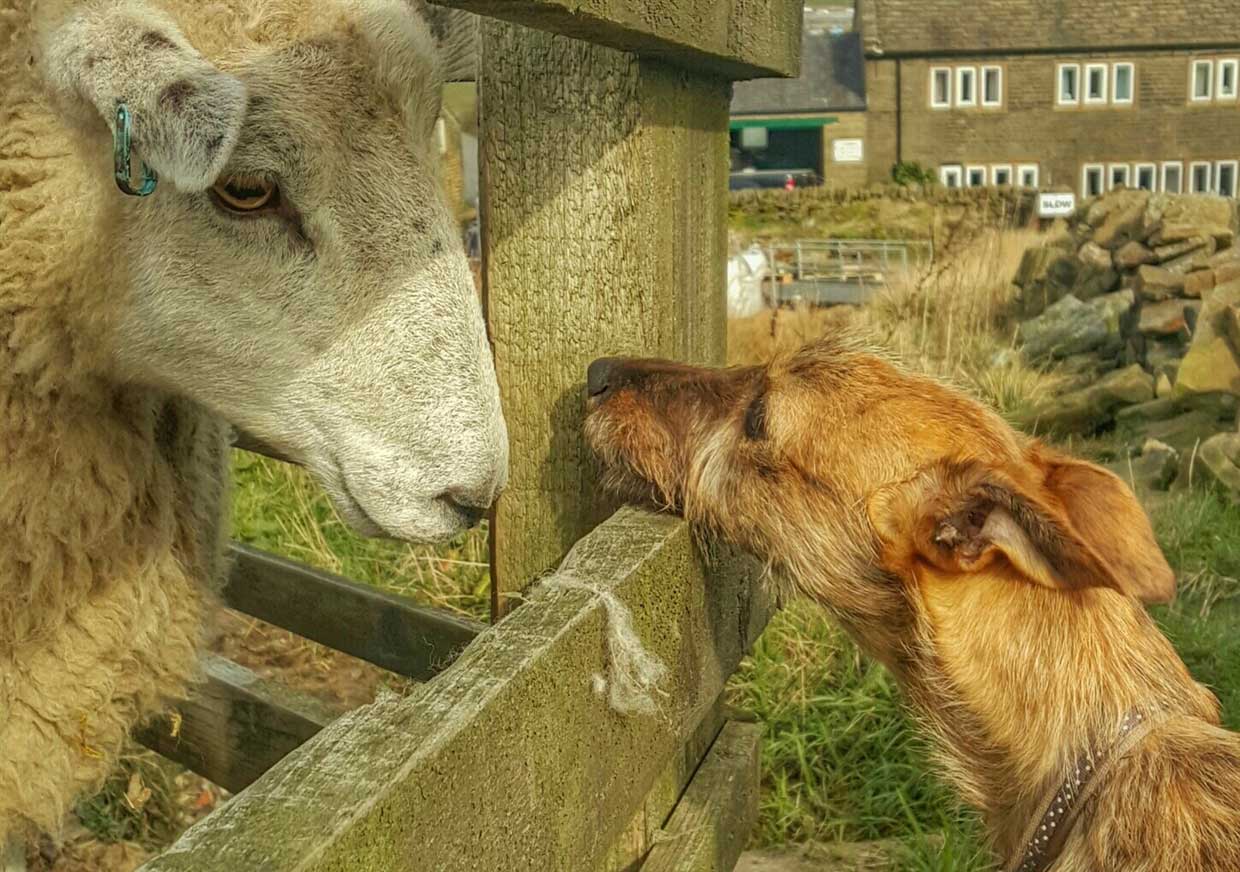
3. Livestock Safety Because of her high prey drive, I was very careful to condition Bea around livestock early. She was introduced to sheep and cows on a farm from a young age.
She is respectful, but I never take chances. In cow fields, she is always close or on a lead—not just for the cows’ safety, but because a 40mph dog can start a stampede in seconds.

The “Character”
Despite the hunting instincts, Bea is a “softie.” She is incredibly affectionate and bonds deeply with her people. She’s also a bit of a clown.
- The Poser: She became famous on my social media because she genuinely loves to pose. If I stop for a photo, she has learned to “sit and wait” perfectly.
- Toy Destroyer: Give her a squeaky toy, and she will “terrorise” it until it is destroyed. Yet, paradoxically, she has a specific teddy bear she cuddles with to sleep.

Essential Care Tips
If you are tempted by the Lurcher life, here are a few specific things to know:
- Feed with Caution: Like many deep-chested breeds, Lurchers are prone to Bloat (GDV), a life-threatening twisting of the stomach. We never exercise Bea for at least an hour before or after food.
- Grooming: Bea’s coat is “rough” (broken), which offers a bit more protection than a smooth coat, but she still needs brushing to stop mats forming behind her ears.
- Paws: Their feet are more sensitive than working breeds. I keep a close eye out for “corns” or cuts on her pads after a rocky hike.

At A Glance: Lurcher vs. The Pack
Here is a table that compares all my current gang with the lurcher.
|
Feature 69521_b5081f-ef> |
Lurcher (Bea) 69521_489aed-1b> |
German Wirehaired Pointer (Pete) 69521_19bdc5-bc> |
Working Cocker Spaniel (Obi) 69521_715b8f-fe> |
Border Collie (Malc) 69521_b8d4c7-3c> |
|---|---|---|---|---|
|
Superpower 69521_1c6dc4-9d> |
Speed (40mph bursts) 69521_1145dc-22> |
Endurance (All-day trotting) 69521_4101f3-f7> |
Busyness (Constant hunting) 69521_ee265a-12> |
Focus (Intense herding) 69521_f52f4b-1b> |
|
“Off-Switch” 69521_694318-fb> |
Excellent (Sleeps 18+ hours) 69521_541110-68> |
Moderate (Needs a job) 69521_410ad4-fd> |
Low (Always “on”) 69521_ed1c7b-76> |
Low (Needs mental work) 69521_997c2c-62> |
|
Recall Risk 69521_066fef-58> |
High (Visual prey drive overrides hearing) 69521_2e99a0-98> |
Moderate (Scent distraction) 69521_ebb93e-45> |
Low/Moderate (Biddable) 69521_89b04f-04> |
Low (Laser focus on owner) 69521_7a9d09-3d> |
|
Cold Tolerance 69521_2518f2-90> |
Low (Needs a coat/layers) 69521_0ea382-35> |
High (All-weather tank) 69521_5a3b85-53> |
Moderate 69521_1a99a7-fb> |
High 69521_23006e-52> |
|
Coat Care 69521_4356c4-a8> |
Easy (But watch for skin tears) 69521_f52717-43> |
Specialist (Stripping/Oily) 69521_773612-29> |
High (Brushing/Burrs) 69521_45f787-cf> |
Medium (Shedding) 69521_25f167-ef> |
Conclusion
Living with Bea has been a different journey to my other dogs. She doesn’t have the work ethic of the Collie or the robustness of the GWP.
But there is something magical about a Lurcher. They are gentle souls who turn into rockets, only to return home and become the world’s most effective hot-water bottles.

She is a “lanky long-legged bundle of joy” , and as long as you can handle the prey drive and the sofa-hogging, they make incredible companions for the trail.
Source link