Japan is a country best experienced on rails. The trains don’t just connect cities — they connect stories.
From Osaka’s neon-lit food streets to Kyoto’s timeless shrines, Hakone’s mountain air, and Tokyo’s electric energy, each stop feels like a new chapter. Travelling by train makes the journey seamless, efficient, and surprisingly enjoyable.
This blog is a diary of our adventure across Japan, stitched together by the rhythm of the rails.

Part 1: Osaka – Neon Nights and Retro Charm
Arriving in Osaka on a sweltering August afternoon, we were immediately introduced to the quirks of Japanese travel: fingerprinting at immigration, a photo that cruelly exposed the rigours of long-haul travel, and my first encounter with high-tech Japanese toilets that made me realise that we are toileting in the dark ages in the west.
Heated seats and bidet options ranging from mountain mist to anti-riot water canon. Armitage Shanks need to up their game.
The train to Namba was smooth and air‑conditioned — a blessing in 36‑degree heat. Our hotel near the station was a cool refuge, though dragging cases through the streets felt like a marathon.
Osaka is a city that wears its heart on its sleeve and that heart is Dotonbori.

The moment you step into Dotonbori, you are greeted by neon signs that blaze across the canal, the famous Glico running man towering above the crowds, and the irresistible smell of takoyaki – dough balls of minced octopus – sizzling on hot plates.
We joined a Secret Food Tour here, and it was the perfect way to dive into Osaka’s culinary soul. One of the many stops included an okonomiyaki cooking class.
Sitting at a hotplate in a tucked-away restaurant, we learned to flip and layer the savoury pancake, adding cabbage, pork, and sauces. All good fun and although I lost marks for presentation it still delivered on taste.
Beyond the food, Osaka Castle stood proudly, its white walls and green roofs rising above the moat. We were watching the TV series Shōgun whilst travelling in Japan so visiting the castle allowed us to step back in time and see stories of samurai battles and feudal lords, aa well as dressing as a samurai for a photo opportunity.
Nipponbashi (Denden Town) was a paradise for anime and manga fans. Rows of shops stacked high with figurines, comics, and electronics created a buzzing atmosphere.
Shinsekai, by contrast, was retro charm at its finest. It was like a Japanese Blackpool – it also has a tower and no end of kitsch shops and arcades but the street food here definitely pips that of the Lancashire coast.
Playing Smart Ball at New Star arcade was a quirky highlight — a nostalgic game of unending pinball where you can convert your winning balls for biscuits – yes biscuits.
Practical Tip: Osaka’s metro is easy to navigate, but grab a prepaid ICOCA card. It saves time and makes travel seamless.
Part 2: Nara – Deer and Temples
Nara was a gentle pause in the journey. Just a short train ride from Osaka on the way to Kyoto, it felt worlds away. The deer park was enchanting — hundreds of deer roaming freely, bowing politely for crackers.

It’s a surreal experience, walking among them as they wander through temple grounds. One deer followed us persistently, nudging for more crackers. When we finally gave in, it bowed three times before trotting off.
Todai-ji Temple was the highlight. The Great Buddha, housed inside one of the largest wooden buildings in the world, radiated calm. Standing before it, you feel small, humbled by centuries of devotion.

Practical Tip: Buy deer crackers from official vendors only. They’re safe for the animals, and the bowing ritual is worth the experience.
Part 3: Kyoto – Tradition and Tranquillity
Kyoto is where Japan whispers its history. At night, Yasaka Shrine glowed softly, lanterns flickering against the dark sky. Nishiki Market was a sensory overload — stalls piled with pickles, sweets, and fresh seafood.

We sampled yuba (tofu skin), a Kyoto delicacy, and matcha sweets that melted in the mouth.
Gion revealed its secrets on a Geisha tour. The world of the Geisha is mysterious and this tour helped to shed a little more light on their world.
We were led around Gion by our guide who talked us through the history of the Geisha before visiting a tea house and audience with a Maiko – an apprentice Geisha – who played us music and read some poetry.
Tourists chasing Geishas for photos is frowned upon but we were allowed a photo with our Maiko friend.

Walking into Arashiyama’s Bamboo Forest feels like stepping into another world. The towering bamboo stalks rise 20 meters high, densely packed so that sunlight filters through in shifting emerald patterns.
The path itself is short but immersive, winding through the grove with shrines and gardens nearby.

Kinkaku‑ji, the Golden Pavilion, is one of Kyoto’s most iconic sights. The temple’s top two floors are covered entirely in gold leaf, shimmering against the backdrop of Kyōko‑chi, the “mirror pond”
Fushimi Inari‑Taisha is the head shrine of Inari, the Shinto god of rice and prosperity. Founded in 711 AD, it’s famous for its thousands of vermilion torii gates, forming tunnels that climb Mount Inari behind the main shrine.
The trails stretch about 4 km and take 2 hours to walk, winding through forested slopes dotted with smaller shrines. It’s a photographers dream.

Similarly, an early morning trip to the Yasaka Pagoda, silhouetted against the skyline, was the perfect postcard moment.
Practical Tip: Kyoto’s temples can get crowded. Visit Fushimi Inari early in the morning or late in the evening for a quieter, more spiritual experience.

Part 4: Hakone – Onsen Bliss and Mountain Views
From Kyoto, the Shinkansen whisked us to Odawara, gateway to Hakone.

Here, life slowed down. At Hakone Nanse Ryokan, evenings meant eight-course kaiseki feasts — delicate sashimi, simmered vegetables, and grilled fish, each dish a work of art and all of our evening meals here were an event.
Mornings, started with traditional japanese breakfast – this was more of challenge for the western palate as clam broth and eel are not on my usual early morning menu.

The omelette that appeared on the last day was the greeted with hugs and high-fives by my wife and I. The areas is volcanic and famed for its steaming onsen baths, the mineral-rich waters easing every muscle, and we had one in our room as well as larger ones in the hotel helped us recharge before Tokyo.
The Hakone Ropeway lifted us above volcanic landscapes, and just for a moment, Mount Fuji revealed itself through the clouds. Sailing across Lake Ashi, the red torii of Hakone Jinja Shrine rose from the water, a sight that felt almost mythical.
The Hakone Open Air Museum was a pleasant surprise — sculptures scattered across rolling hills, Picasso ceramics tucked away in a gallery, and children playing among giant installations. It’s definitely worth a visit if you are in Hakone.

Practical Tip: Hakone’s transport system is a loop — trains, cable cars, ropeways, and boats all connect. Buy the Hakone Free Pass for unlimited rides; it makes exploring effortless. Buses from Odawara station take you through the Hakone region.
Part 5: Tokyo – Energy, Innovation, and Farewell
Tokyo was the crescendo. It is vast, manic, and amazing yet still has Japanese order to keep you in check. Shibuya Crossing pulsed with life, thousands of people moving in perfect chaos.
From Shibuya Sky, the city stretched endlessly, a sea of lights and towers. Shinjuku’s 3D billboards danced above us, while Akihabara was a paradise for anime and manga fans.
Towering shops stacked with figurines, comics, and electronics created a buzzing atmosphere — a modern counterpart to Kyoto’s traditions.

Slurping spicy pork ramen under Yurakucho’s rail arches with the after work crowd, the sound of trains rumbling overhead, is a must do.
The food is amazing and was very well priced (£30 total for two people having starters, noodles, and two beers each).
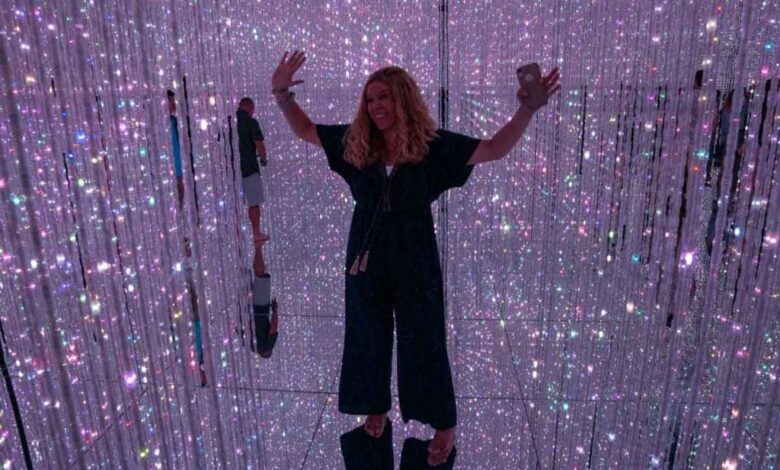
There were two standout experiences for us in Tokyo.TeamLab Planets immersed us in digital wonder — wading barefoot through water filled rooms with light-created koi carp spectres swimming around us, floor-to-ceiling glowing matrix-like installations, and a floating flower garden. It is a feast for your senses and a truly magical sensory experience.
Then came the thrill of racing through Tokyo on go-karts, we went with Street Kart — skyscrapers flashing past like a video game.

If you hang around in Shibuyu long enough you will see karts travelling by with people dressed as Super-Mario characters.
It was 38 degrees on our karting day so we stuck with shorts and t-shirt rather than dressing like a football mascot, but driving around the streets of Tokyo was a real highlight.
Zojoji Temple and Tokyo Tower gave us moments of reflection, before dinner at The Jade Room and Garden Terrace, where Tokyo’s skyline sparkled like a jewel. Senso-ji Temple and Skytree Tower showed Tokyo’s duality — ancient and futuristic.

The Ninja Samurai Experience added playful adventure as we practiced our ninja-star throwing skills, while Hakushu Teppanyaki gave us a farewell feast: Kobe beef cooked to perfection by an 88-year-old chef whose skill was as timeless as the city itself. The most memorable meal we had.

And then, one last walk across Shibuya at night — neon lights, bustling crowds, and the bittersweet feeling of a journey’s end.

Practical Tip: Tokyo’s metro is vast but efficient. Jorudan is the best for precise train schedules and platform numbers in Japan, and don’t miss the chance to eat under Yurakucho’s arches — it’s Tokyo at its most authentic.
Planning your trip
The Japan Guide website is a brilliant travel resource for tourists to help plan your trip, find tours, discover sites, and learn about Japanese culture and etiquette.
SIM/eSIM cards
Your phone is going to be an invaluable resource for navigating Japan. Shinjuku station has 200 exits so finding the right one without a phone is, well, a 200-1 shot.
We purchased a SIM card on arrival at Osaka airport and used with a spare phone but eSIMs are also great and now my preferred travel solution.
Flights
We organised the trip independently booking all flights, accommodation, experiences, and train travel directly.
We flew from Manchester to Osaka via Abu Dhabi with Etihad airlines and back from Tokyo on the same route. It’s a long old way back to the UK from Japan, so if we had the time we would have arranged a stop over in Abu Dhabi to break up the journey but we wanted to maximise our time in Japan.
You could also plan a stop over in South Korea or other country depending on your airline.
Accommodation
I found hotels to be cheaper than Europe or the US but rooms can be smaller, particularly in the cities and you may need to check if you are getting a western or Japanese style bed – a futon rolled out on a mat is often standard in ryokans.
We splashed out a bit more for our ryokan in Hakone and this area was generally more expensive than the cities but the hotel we stayed in was fabulous.

Prepaid IC Cards
Japan’s rail and metro systems are intuitive once you know the basics. Prepaid IC Cards can be picked up at ticket machines and recharged as you need them.
They can be used interchangeably across major cities for most forms of transport, but shinkansen is a bit more fiddly and best booked ahead.
We booked the bullet train online before we left using the Japan Rail website. I found this a simple process with tickets saved to mobile phones.
If you are staying for longer and doing lots of train travel then it may be worth considering the Japan Rail Pass which gives tourists unlimited travel for a time period, but you will need to be making several journeys to make that worth while. Further details below on trains
Best Way from Osaka Kansai Airport to City
- •JR Haruka Limited Express: Direct to Tennoji (30 min), Osaka Station (45 min), Shin-Osaka (50 min). ¥1,820–3,470 depending on seat type.
- •Discount Haruka Ticket: For foreign tourists, one-way fares as low as ¥1,300–1,800.
- •Nankai Rapi:t Express: Direct to Namba (Dotonbori area) in ~40 minutes.
- •Booking: Tickets at airport counters, vending machines, or online.
- •Tip: Choose Haruka if heading to Osaka/Umeda or Shin-Osaka; Nankai Rapi:t if staying near Namba/Dotonbori.
Booking Trains Between Osaka, Nara, and Kyoto
- •JR Yamatoji Line: Direct rapid trains run from JR Osaka Station to JR Nara Station in about 45 minutes (¥510–840). Covered by the Japan Rail Pass.
- •Kintetsu Railway: From Osaka-Namba Station to Kintetsu Nara Station in ~30 minutes. Limited Express costs ¥1,200–1,300, Express ¥680. Not covered by JR Pass.
- •Nara to Kyoto: JR Nara Line connects Nara to Kyoto in ~45 minutes. Kintetsu also runs direct trains to Kyoto Station.
- •Booking: Tickets can be purchased at station machines, ticket counters, or reserved online for Limited Express trains.
Shinkansen Kyoto → Odawara (Hakone)
- •Route: Take the Tokaido Shinkansen (Hikari or Kodama). Fastest journey ~1h 54m.
- •Booking:
- ◦Online via JR Central’s official site.
- ◦Third-party platforms like Klook or Japan Experience.
- ◦At ticket machines or counters in Kyoto Station.
- •Tip: Reserve seats for comfort; left hand side window seats offer views of Mount Fuji on clear days.
Shinkansen Odawara → Tokyo
- •Route: Tokaido Shinkansen (Kodama, Hikari, or Nozomi). Journey ~30–40 minutes.
- •Booking: Same as above — JR Central site, Klook, or station counters.
- •Tip: If you’re staying in Hakone, Odawara Station is the Shinkansen hub.
Train to Narita Airport (Tokyo → Narita)
- •Narita Express (N’EX): Direct from Tokyo Station to Narita Airport in ~53 minutes.
- •Keisei Skyliner: From Ueno or Nippori to Narita in ~40 minutes.
- •Booking: Tickets available at JR East counters, online reservations, or vending machines.
- •Tip: N’EX is best if you’re near Tokyo/Shinjuku/Shibuya; Skyliner is faster if you’re near Ueno.
Source link