Hong Kong’s focus on AI breakthroughs entices healthcare and robotics firms


Artificial intelligence (AI) – computer systems that can copy intelligent human behaviour – is rapidly transforming our world. The growing use of smart technologies in our homes and businesses, including facial or image recognition, data analysis, language understanding, problem-solving, robots and self-driving vehicles, is helping to enhance traditional human capabilities.
Hong Kong, recognised as an international finance centre with a stable digital infrastructure and hi-tech regional business hub that supports innovation and talent, is also positioning itself as a strategic base for AI development.
Its long-established, unrivalled connectivity with mainland China and the rest of the world is helping it serve as a leading example of how major cities can embrace – and successfully integrate – smart technologies into a diverse range of industries.
In his 2025 policy address, Chief Executive John Lee Ka-chiu pledged to “step up the promotion of AI as a core industry for Hong Kong’s development”. The city has committed HK$1 billion (US$128 million) to accelerate breakthroughs in AI research and strengthen the links between academia and industry by establishing the Hong Kong Artificial Intelligence Research and Development Institute next year.
AI and data science has also been designated as one of five strategic industries under Hong Kong’s Office for Attracting Strategic Enterprises (OASES), a government body launched in 2022 to encourage high‑potential global and mainland companies to set up operations in the city. Up to October, it had attracted over 100 strategic enterprise partners, HK$60 billion in investment, and generated about 22,000 local jobs.
Xunfei Healthcare, which was founded in 2016, and specialises in AI‑driven diagnostics, digital therapeutic and clinical decision support for primary care physicians, is one notable entrant in this sector. Its parent company, iFlytek, which was established in Hefei, Anhui province, in 1999, is a leading company in the development and provision of AI speech and language technology.
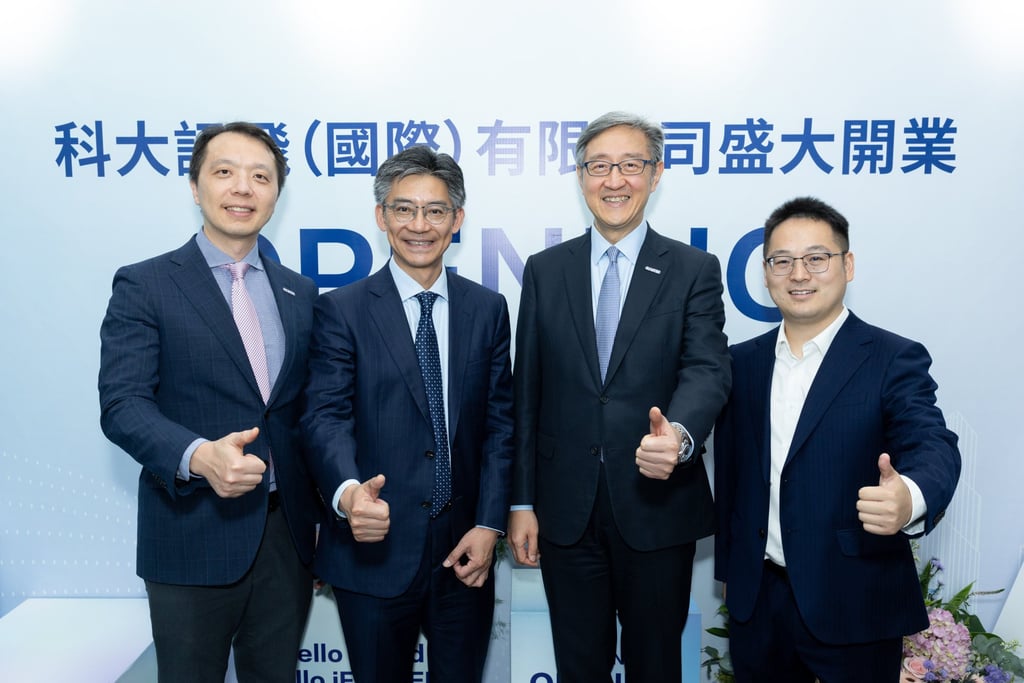
In November last year, iFlytek and its subsidiary Xunfei Healthcare became strategic enterprises of OASES. In July they announced they would invest HK$400 million in Hong Kong over the next five years on facilities at Cyberport, in Pok Fu Lam, on Hong Kong Island, including the international headquarters, housing a 150-strong team, and Xunfei Healthcare’s research institute focused on cutting-edge AI and health technology integration.
Dr Tao Xiaodong, president and executive director of Xunfei Healthcare, says his company’s main focus in Hong Kong will be establishing its research institute, which will serve as a global innovation hub that can empower specialist teams in hospitals.
“A diverse ecosystem of established firms and start-ups in biotech and AI in the city helps to accelerate the process of turning research into practical solutions,” he says.
“Together with its world-class medical professionals, who possess knowledge of the latest advances in the field and local clinical insights, Hong Kong offers the ideal environment to encourage innovation.”

Xunfei Healthcare is carrying out joint projects with local hospitals and universities to exchange insights into technology and enhance applications. The goal is to improve the efficiency and quality of healthcare services to ultimately benefit more people.
Its digital health-advisory app, Xiaoyi, which uses its large medical language model to simulate doctor-patient dialogues for symptom checking and medication guidance, can analyse medical reports and monitor chronic disease indicators for early risk assessment.
Up to November, the app had been downloaded 26 million times and completed over 160 million AI consultations. The Hong Kong version can be used to provide symptom assessment in both Cantonese and English, medication consultation, traditional Chinese medicine syndrome identification and personal health record management.
The company has also recently launched its Spark Medical Large Language Model, an AI platform for healthcare applications, and an enhanced version of Xiaoyi – both of which aim to help Xunfei Healthcare continue to gain deeper insights into health.
OASES supported Xunfei Healthcare’s expansion to the city, including providing assistance in site selection, policy navigation and establishing connections with local partners. These efforts have helped the company push forward with its research and development (R&D) collaborations and leverage the city’s global financial expertise to access new Southeast Asian markets.
“Hong Kong remains one of the world’s top capital markets,” Tao says. “Leveraging its advantages as an innovation hub and ample resources in research talent and funding, we can continue to accelerate our operations and the internationalisation of medtech [medical technology used in healthcare devices, software and systems for diagnosis, treatment and patient monitoring].”
If AI is the brain of smart technology, then robotics serves as the body. The global market value of embodied AI – systems that are integrated into physical systems, such as robots or autonomous vehicles to allow them to perceive, interact with, and learn from their surroundings in real time – is projected to reach US$13.8 billion by 2028.
Hong Kong’s high service-industry density and proximity to the southern Chinese city of Shenzhen’s robotics supply chain provide an ideal testing ground for this fast-rising sector.
Galbot, an innovation and technology company founded in Beijing in 2023, is one of the businesses that is benefiting from the synergistic relationship between the two cities as it expands globally.

Last year it teamed up with the Hong Kong Investment Corporation (HKIC) – the city government’s investment arm – to establish the Hong Kong‑Galbot Embodied AI Lab, which will focus on developing humanoid robots for retail, logistics and hospitality while training students and technicians in practical robotics skills.
The company also set up an office at Hong Kong Science Park earlier this year to gain access to the city’s research talent, and logistics and financial infrastructure to streamline its global operations by reducing overseas delivery times and simplifying fund transfers. It also became an OASES strategic enterprise in October and is currently the only such company specialising in embodied AI.
OASES has assisted Galbot with introductions to R&D scientists, funding channels and strategic ecosystem partners while helping the company navigate local regulations and align with Hong Kong’s innovation programmes and initiatives.
The office is also supporting Galbot’s expansion into the Japanese market and broadening its global reach. Its support not only advances embodied AI but also reinforces Hong Kong’s role as a global hub for intelligent robotics deployment.
Jason Chen, vice-president of Galbot, says, “Becoming an OASES strategic enterprise brings us greater responsibility to contribute to the development of Hong Kong’s AI and robotics capabilities. We believe robotics holds strong potential here. The challenge is acceptance among the public, as it’s still a new concept.”
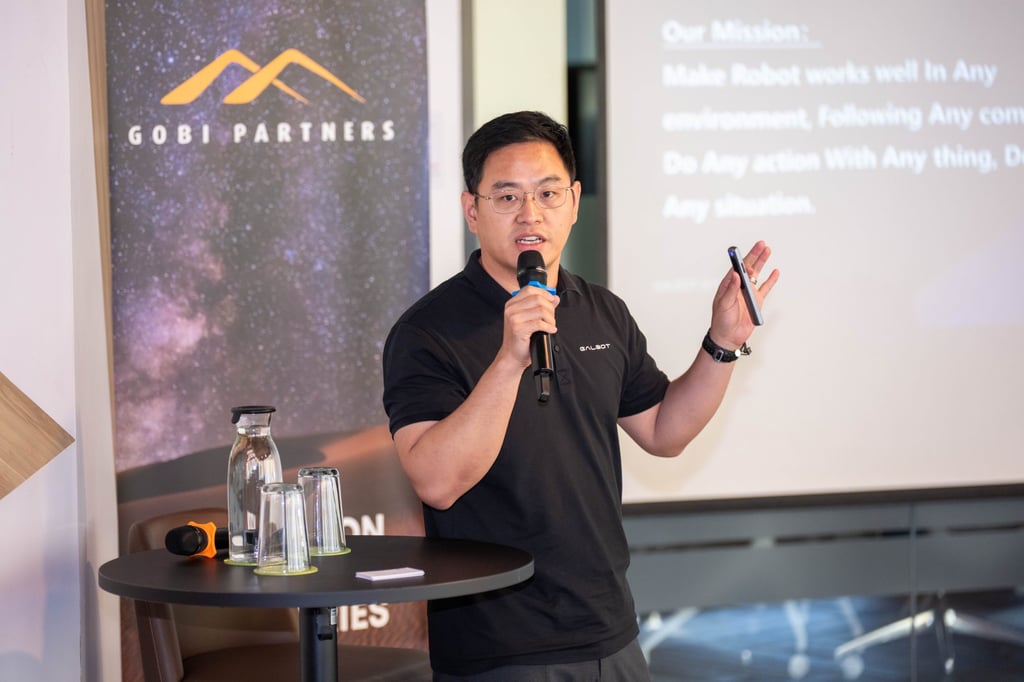
The company has initiated the deployment of its humanoid robots in retail and hospitality settings, including collaborating with property developers such as New World Development and China Resources Group to launch pilot projects at shopping malls, public spaces and MTR stations. Galbot is also partnering with HKU, PolyU and the Chinese University of Hong Kong on research into AI, robotics and materials R&D.
Galbot plans to co-host Hong Kong’s first International Conference on Embodied AI Robot with HKIC next year, which will showcase the latest developments in the field in front of representatives from leading tech companies, academic institutions and investment companies.
“Hosting a conference like this in Hong Kong is great because the city can gather talent from around the world, especially in robotics, AI and data science,” Chen says. “Our partnerships with OASES and HKIC will enable us to showcase our products and solutions and build more trust and credibility in the market.”
Source link