When most people think of Leicestershire, they tend to think of it as being rather flat. Well, let me tell you, they haven’t explored the rolling wolds of “High Leicestershire.”
While Bardon Hill over in Charnwood takes the official title of the “Roof of Leicestershire” (a spot I’ve written about elsewhere), the views from here in the east are every bit as dramatic.
This 6-mile loop is a perfect example of why I love this area—a place where you can stand on an Iron Age rampart with the wind in your hair, gaze out over a sea of green, and feel the centuries of history beneath your boots.

The walk takes us from the commanding heights of Burrough Hill, down into the valley to the charming village of Somerby—where, believe it or not, we might just find the true home of Stilton cheese—and back again via a spot that changed the course of Royal history.

Starting on the Summit
We start our adventure at the Burrough Hill Country Park. The car park here is a Pay & Display (card or PayByPhone), and it sits right on the edge of the escarpment. As soon as you step out of the car, you can feel that you are high up.
The walk begins with a gentle climb up a metalled track towards the hillfort.

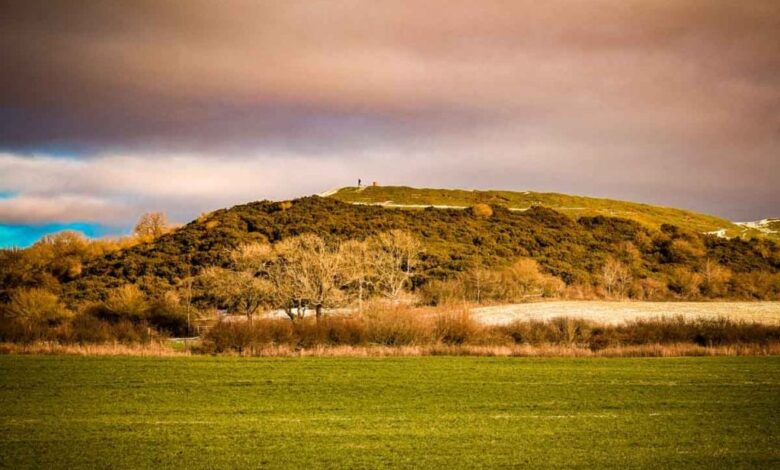
It’s a transition that takes you from the modern world straight into prehistory. Burrough Hill is an Iron Age hillfort, and it is a beast. Sitting at 210 meters (690 ft) above sea level, it’s one of the highest points in the county.
Walking through the gap in the massive ramparts, you enter what was once the bustling “capital” of the Corieltauvi tribe.
It’s peaceful now, grazed by sheep and cattle, but 2,500 years ago, this was a place of power. In 2013, archaeologists even found a hoard of bronze chariot fittings here, buried as a religious offering.

I recommend taking a lap of the ramparts first. The views are simply spectacular, stretching out across the Wreake Valley. On a clear day, you can see for miles. There’s a Toposcope at the southwest corner to help you get your bearings.
Into the Wolds and the Viaduct
Leaving the fort, we head down the steep slope, joining the Leicestershire Round. This is where you need your sturdy boots, as the clay tracks can get a bit sticky in winter!
As we descend into the valley, the landscape opens up into a tapestry of fields and woodland.

Keep your eyes peeled for the John O’ Gaunt Viaduct in the distance.
It’s a stunning 14-arch brick structure that once carried steam trains between Melton Mowbray and Market Harborough. It’s been silent since the 1960s, a sleeping giant in the middle of the countryside.
The path weaves through farmland—this is proper working country, so do keep the dogs on leads around the livestock.
The hedgerows here are full of life; if you’re lucky, you might spot a Brown Hare darting across the stubble or hear the trill of a Skylark high above.

Somerby and the Cheese Debate
About halfway round, we reach the village of Somerby. It’s a lovely spot, full of golden ironstone cottages that glow in the sunlight.
Now, it’s time for a well-earned break. We are heading to The Stilton Cheese Inn, a fantastic 16th-century pub right on the High Street.

You might be wondering about the name. We all know Stilton is famous, but did you know it actually comes from around here?
The story goes that Cooper Thornhill, an 18th-century innkeeper, sold the cheese at his inn in the village of Stilton (in Cambridgeshire), but he bought it from the farmers’ wives right here in Leicestershire.
Today, under Protected Designation of Origin (PDO) laws, you can’t even legally make Stilton in the village of Stilton! It has to be made in Leicestershire, Nottinghamshire, or Derbyshire.
So, you are in the spiritual home of the “King of Cheeses.” Naturally, I had to sample the goods.

The pub serves a proper Ploughman’s Lunch with a generous wedge of local Stilton for £12.95. If you want something warmer, their homemade Somerby Sausages and mash are just the ticket for a hungry hiker.
A Royal Romance and Wartime Bravery
Refueled, we head out of Somerby. If you are so inclined you can take a bigger detour towards Burrough Court. A nearby estate that has an incredible story to tell.
In the 1930s, this was the hunting lodge of Lord Furness. It was here, at a house party in January 1931, that the Prince of Wales (the future King Edward VIII) first met Wallis Simpson.
That meeting sparked the romance that eventually led to the Abdication Crisis. Walking past these quiet fields, it’s wild to think that the fate of the British Monarchy turned on a conversation had right here.
The main house sadly burned down during World War II, apparently caused by troops from the 10th Battalion, Parachute Regiment, who were trying to crack open the wine cellar with explosives!.
Speaking of the 10th Battalion, there is a moving memorial nearby. The battalion was billeted in Somerby and Burrough before flying out to the Battle of Arnhem in 1944. It’s a sobering place to pause and pay respects to the “Friends of the Tenth”.

The Return Leg: Knights and Pubs
The final leg of our walk takes us back across the fields to the village of Burrough on the Hill. It’s a gentle finish, crossing pastures that still show the ridge-and-furrow marks of medieval ploughs.
Before you finish, there is one last historical gem to uncover in the village itself. St Mary’s Church is well worth a peek.

It’s a beautiful medieval building made of that warm, local ironstone. Inside, keep an eye out for the 15th-century alabaster effigies of William Stockton and his wife Margaret. William is depicted in armour with his feet resting on a lion, a wonderful little detail that has survived for centuries.
There is also a font that dates all the way back to the 13th century, which has likely baptized generations of villagers living in the shadow of the hillfort.
If you didn’t stop in Somerby, you have another chance for refreshment at The Stag and Hounds in the village.
It’s a top-notch gastropub that has even earned a Michelin Bib Gourmand. They serve “Burrough Hill Hogget,” raised on the very hill we just climbed!

From the village and church, it’s a track back up to the Country Park car park via climbing the Iron Age Hill Fort once more.
As you drive away, take one last look at the hillfort silhouetted against the sky. It’s a landscape that has seen Iron Age warriors, Roman farmers, Viking settlers, and Royal lovers. And for a few hours, it was ours too.

Happy Walking!
If you are looking to do more walks in Leicestershire with history then an example take a look at: Bradgate Park: A Gem Of Leicestershire
Or maybe you would like to Join us on the next Leicestershire 3 Peaks Guided Walk!
Source link