This is the unglamorous part of wildlife gardening, but it is undoubtedly the most important. If you aren’t prepared to clean, you shouldn’t feed.
When we hang a feeder, we are inviting wild animals to do something unnatural: congregate in high densities in a very small space. In the wild, birds forage over acres.
In our gardens, twenty Goldfinches might visit the same square inch of plastic perch in an hour.
This creates a “super-spreader” event for diseases. Without strict hygiene, your kindness can accidentally become a catastrophe.
The Silent Killer: Trichomonosis
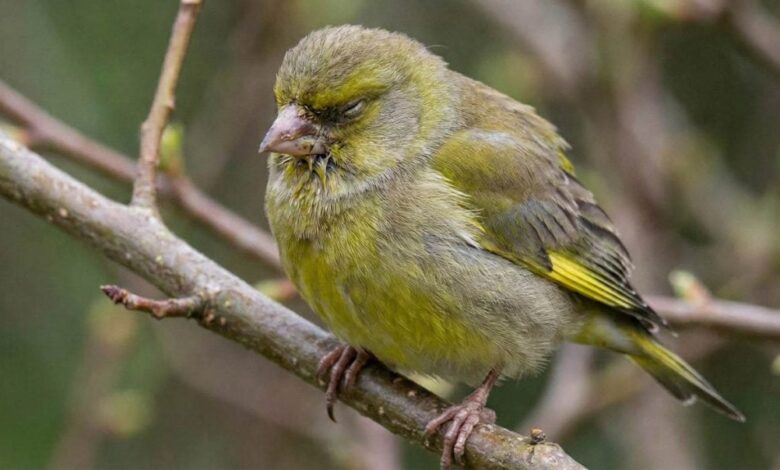
In recent years, the UK’s Greenfinch and Chaffinch populations have crashed (Greenfinches down 60% since 2005). The primary culprit is Trichomonas gallinae, a microscopic protozoan parasite.

The Mechanism: The parasite infects the bird’s throat and gullet. It causes cheesy lesions that swell up until the bird can no longer swallow. The tragic irony is that the bird sits on a pile of food, starving to death because it physically cannot eat.
Transmission: It spreads through saliva. When a sick bird struggles to eat a seed, it often regurgitates it back onto the feeder or into the water bath. The next bird eats that contaminated seed and ingests the parasite.
The “Stop-Clean-Wait” Protocol: If you see a bird that looks fluffed up, lethargic, or has a wet, matted beak (a sign of regurgitation), you must act immediately.
- STOP: Cease feeding immediately. Empty all feeders.
- CLEAN: Disinfect everything using the protocol below.
- WAIT: Leave feeders empty for 2-3 weeks. This forces the flock to disperse and feed naturally in the wider countryside, breaking the chain of transmission.
The Veterinary Cleaning Protocol
A quick rinse under the tap is not enough to kill parasites or bacteria like Salmonella. You need a chemical kill step.
Frequency: Weekly (Year-round). Equipment: A dedicated scrubbing brush (never use your kitchen brush!), rubber gloves, a bucket.
The Method:
Scrub: Remove all droppings and crusted old seed. Organic matter deactivates disinfectants, so the feeder must be visually clean before you sterilize it.
Sterilize: Use a 5% sodium hypochlorite solution (mild household bleach).
- Ratio: Mix 1 part bleach to 19 parts water.
- Alternative: Use a dedicated veterinary disinfectant like Ark-Klens or F10. (Note: Vinegar is often not strong enough to kill robust parasites).
Soak: Let the feeders soak for 15 minutes.
Rinse: This is vital. Rinse thoroughly with fresh water to remove all chemical residue.
Dry: Air dry completely. Trichomonas needs moisture to survive; drying is a secondary kill step. Never refill a damp feeder, as the seed will rot.
The Rat Problem: Deterrence, Not Poison
Rats are wildlife too, but they aren’t usually welcome guests at the bird table.
Using poison in a wildlife garden is a terrible idea—it enters the food chain.
A poisoned rat is a slow-moving target for an Owl, Kestrel, or Fox, which then dies of secondary poisoning.
Strategy 1: Physical Exclusion (Baffles)
Rats and American Squirrels are incredible climbers, but they cannot defy physics.

The Solution: Install a Squirrel/Rat Baffle (a large plastic dome) on your feeder pole.
Placement: The baffle must be at least 1.2m off the ground. The pole must be away from fences or trees (rats can jump). If done correctly, the rat cannot climb past the dome to reach the food.
Strategy 2: The Chilli Trick
This is a brilliant biological hack.
The Science: Mammals (rats, squirrels, humans) have receptors that feel the “heat” of capsaicin (chili). Birds do not. They literally cannot taste the heat.
The Action: Buy bird seed dusted with chilli powder or mix in some cayenne pepper yourself. The birds will eat it happily (it’s actually a good source of Vitamin A). The rats will take one sniff, get a nose full of fire, and run a mile.

Strategy 3: Hygiene & Storage
- No Ground Feeding: If you have rats, stop throwing food on the floor immediately.
- Metal Bins: Store your bulk bird food in metal bins (old dustbins are great). Rats can chew through thick plastic tubs in minutes.
- The Peppermint Myth: You will read that peppermint oil deters rats. While they dislike the smell, it is rarely effective long-term in an outdoor setting as the scent dissipates too quickly. Physical barriers are far superior.
It is a delicate balance. You may be ground feeding Badgers but end up with a rat problem.
Source link