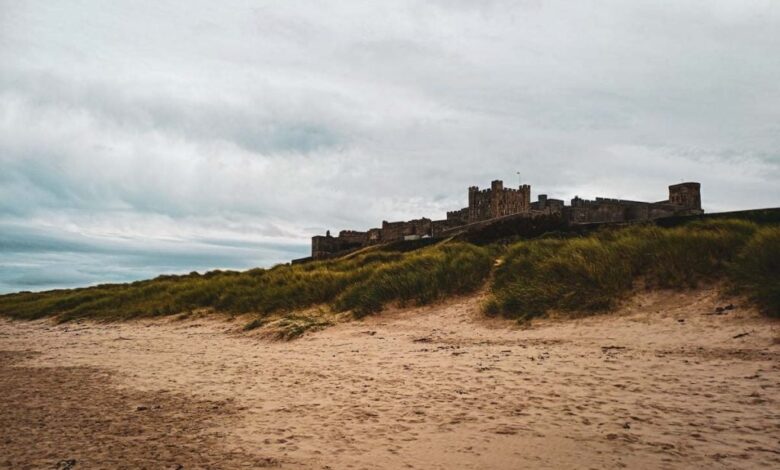
I’ve walked countless miles of the British coastline, but I’m not sure any view stops me in my tracks quite like Bamburgh.
It doesn’t just sit on the horizon; it dominates it—a sprawling, red-stone giant that seems to grow straight out of the volcanic rock, defying the North Sea winds for over a thousand years.
Standing on the beach below with the salt spray in the air, you don’t just see a fortress; you feel it. It looms over the skyline like a sleeping lion.

For anyone who loves a good walk followed by a deep dive into history (and perhaps a very large scone), this is the holy grail.
On my recent trip, I spent hours just walking the perimeter trying to capture the sheer scale of the “King of Castles.”
If you’re planning a trip to the Northumberland coast, here is my deep-dive guide to exploring the real Bebbanburg—from the hidden aviation history to the best photo spots and the tastiest post-hike feasts.

The View from the Whin Sill
The first thing that strikes you is the geology. The castle sits on the Great Whin Sill, a ridge of volcanic dolerite that is roughly 295 million years old.
The stretch of rock we have discovered many times here on Baldhiker travels and walks in other dramatic locations like Hadrian’s Wall and the magnificent High Cup Nick. High Force waterfall was created via the Whin Sill too.
For photographers, this rock is your best friend. I found that the best “profile” shots aren’t actually from the castle entrance, but from the beach below.
Top Photo Spots
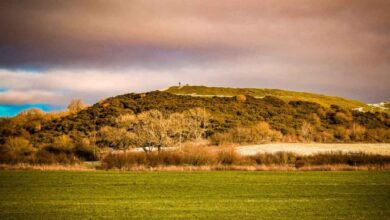
The Cricket Pitch: It sounds quintessentially English, and it is. There is a cricket pitch right at the base of the castle walls. If you stand on the boundary edge, you can capture the lush green grass contrasting with the brooding, dark stone of the fortress above. It’s a shot that perfectly captures the village’s mix of domestic life and military history.
Stag Rock (The Reflection Shot): Walk north along the beach, away from the castle, to Blackrocks Point. Here you’ll find a large rock with a white stag painted on it. The origins of this stag are a local mystery that adds to the charm. Some say it marks the spot where a stag leaped into the sea to escape hunters (legend claims St. Aidan made it invisible to save it), while others insist it was originally painted by Italian prisoners of war during World War II.
Pro Tip: If you catch the tide just right (low to mid-tide), the rock pools here act as perfect mirrors. You can get that stunning reflection of the castle with the “nuclear” colours of a Northumberland sunrise if you’re an early riser.
The Dunes: In high summer, the dunes are alive with wildflowers. Framing the castle through the tall grass and red poppies softens its rugged edges and adds a beautiful splash of colour to your photos.

From Flamebearers to Gunpowder: A Brief History
Before you step inside, it’s worth understanding just how much “life” this rock has seen. It wasn’t always the stone giant we see today.
The Anglo-Saxon Capital: The site was originally a Celtic fort known as Din Guarie. In 547 AD, it was captured by the Anglian king Ida the Flamebearer.
His grandson later renamed the fortress Bebbanburg after his favourite queen, Bebba. For centuries, this was the Royal Capital of the Kingdom of Northumbria, a power centre that rivalled anywhere in England.
A Violent Record: Bamburgh holds a dubious distinction in military history. During the Wars of the Roses in 1464, it became the first castle in England to be defeated by gunpowder.
The massive cannons of King Edward IV smashed the walls, ending the age of the impregnable medieval castle and leaving it a ruin for centuries.
The Victorian Resurrection: We owe the castle’s current grandeur to William Armstrong. A Victorian industrialist and inventor, he bought the crumbling ruin in 1894 and spent a fortune restoring it into the “fairy tale” fortress that dominates the coast today. It is still the private home of the Armstrong family and you can check the Bamburgh Castle site for current opening times.

Hidden History: Spitfires and Windmills
Most people come for the medieval history, but Bamburgh hides some bizarre secrets that you won’t find in the average guidebook.
The Armstrong and Aviation Museum
In the castle’s West Ward, housed in the former laundry rooms, you’ll find something entirely unexpected: a museum dedicated to aviation.
It seems out of place in a medieval fortress, but it celebrates William Armstrong, the Victorian inventor who bought and restored the castle.
Armstrong was a genius engineer (often called the “Magician of the North”), and his company, Armstrong Whitworth, later built aircraft.
The museum is fascinatingly weird, packed with wreckage from World War II Spitfires, engines, and artillery. It’s a stark, metallic contrast to the ancient stone walls outside.

The Castle Windmill
While exploring the West Ward, keep an eye out for the stone windmill tower near St. Oswald’s Gate. It’s a rare feature for a fortified castle. While long believed to be medieval or from the 18th century, recent research suggests it was likely built by Lord Armstrong to allow locals to mill their grain—a functional piece of industrial history sitting right next to the dungeons!
The Real “Last Kingdom”
You can’t talk about Bamburgh these days without mentioning Uhtred of Bebbanburg. As a fan of The Last Kingdom, standing here felt a bit like a pilgrimage.
While the Uhtred from the Netflix series is a fictionalized character, he is based on a very real historical figure: Uhtred the Bold, who was indeed the Earl of Northumbria in the early 11th century.
The castle embraces this connection with its “To Valhalla” exhibition, where you can see actual costumes and props from the show. Seeing the swords up close really drives home the reality of the violence that once surrounded these walls.

Walking the Coast: Two Essential Routes
The best way to understand the scale of Bamburgh is to walk it. The coast here is part of the Northumberland Coast National Landscape, meaning the trails are well-maintained and stunningly scenic.
Here are the two routes I recommend:
1. The Budle Point Loop (Approx. 4 miles / 6.5km)
This is my favourite circular walk.
- The Route: Start at the castle, head north along the beach past Stag Rock to Budle Point.
- The View: The views into Budle Bay are incredible—it’s a huge tidal mudflat that is a haven for birds. You can loop back along the top of the escarpment via the golf course path.
- Why do it: It’s relatively flat, easy for dogs (Bandit loved the dunes), and offers constant, changing views of the castle.
2. The Spindlestone Heugh Detour
For the folklore lovers, take the short walk (or drive) south to Spindlestone Heugh.
This crag is the setting for the Laidly Worm legend, where a princess turned into a dragon was said to hide. You can still see the “trough” in the rock, and the views back toward the castle are moody and dramatic.

A Post-Hike Feast
Let’s be honest, no adventure is complete without food. The sea air here builds up a ferocious appetite, and Bamburgh village punches well above its weight for culinary gems.
For Tea and Cake: The Copper Kettle
This is one of those places that feels like a warm hug. It’s a traditional tea room on Front Street that has been recognized as one of the finest in the country.
- What to order: Their fruit scones. They are beautiful, big, and fat—served warm with generous pots of jam and clotted cream. It’s the perfect fuel after a few hours of dune-walking.
For a Seafood Dinner: The Potted Lobster
If you want something a bit more substantial, you have to try The Potted Lobster. It has a lovely, relaxed “beach hut” vibe but the food is serious quality.
- The Dish: Unsurprisingly, the signature dish is the Potted Lobster itself, but I also love their Shetland mussels in white wine sauce. They source their smoked haddock from Swallow Fish in nearby Seahouses.
Note: You must book ahead. It’s incredibly popular, and for good reason.
Janine’s Practical Tips
- Getting There: The “Links” car park opposite the castle is often easier (and better for beach access) than the main castle car park, which has a steep incline.
- Accessibility: If you struggle with the steep paths, the castle offers a shuttle buggy. For the beach, check out Beach Access North East—they loan out all-terrain beach wheelchairs for free!
- Dog Friendly: The beach is a paradise for dogs. The castle grounds are dog-friendly, though they can’t go inside the state rooms. The Copper Kettle has a lovely courtyard where your four-legged friends are welcome.
Bamburgh is more than just a tick-box tourist site. It’s a place of texture—rough stone, soft sand, crashing waves, and the taste of salt and sugar.

Whether you’re chasing the ghost of Uhtred, hunting for the white stag, or just chasing the perfect sunrise, it’s a corner of England that stays with you long after you’ve shaken the sand from your boots.
Other castles you may wish to explore in the UK.
Source link