Molecular carbon detected in the planet’s atmosphere, possibly extending to a diamond-rich core
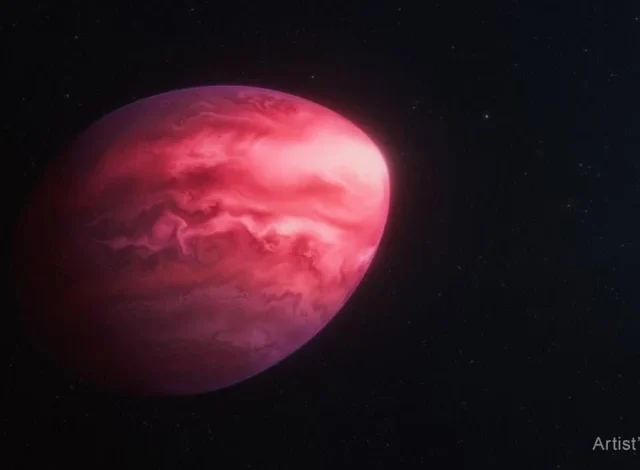
This artist’s concept shows what the exoplanet PSR J2322-2650b, which orbits a pulsar, may look like. Because of its extremely tight orbit, the planet’s entire year — the time it takes to go around the pulsar — is just 7.8 hours. Gravitational forces from the much heavier pulsar are pulling the Jupiter-mass world into this bizarre lemon shape. PHOTO: NASA
Astronomers have discovered an unusual lemon-shaped exoplanet orbiting a pulsar, a type of dense, rapidly spinning dead star, in a finding that challenges current theories of planet formation.
Using the James Webb Space Telescope, researchers observed that the planet, dubbed PSR J2322-2650b, possesses an atmosphere rich in carbon but completely lacking nitrogen and oxygen—elements typically found wherever carbon exists in the universe. “Everywhere in the universe, where there’s carbon, there tends to be nitrogen and oxygen,” said Michael Zhang, a postdoctoral researcher at the University of Chicago and co-author of a preprint paper detailing the discovery, soon to be published in Astrophysical Journal Letters.
The Jupiter-mass gas giant orbits its pulsar host closely enough that the star’s gravity has deformed the planet into a lemon-like shape. While gas giants orbiting ordinary stars are known to be slightly distorted, this extreme deformation is unprecedented.
Researchers also detected molecular carbon in the planet’s atmosphere, which may extend to its core, potentially in the form of diamonds.
The formation of PSR J2322-2650b remains a puzzle. Conventional models struggle to explain how a planet with such a unique chemical makeup could form around a pulsar. One hypothesis suggests that the planet could be the stripped remnant of a former star, although this does not account for the missing oxygen and nitrogen.
“I’m open to the possibility that this is an entirely new type of object,” Zhang added, highlighting the discovery’s potential to reshape our understanding of planetary science.
Source link