US Envoy Witkoff announces phase two of Gaza plan after Palestinian talks in Egypt
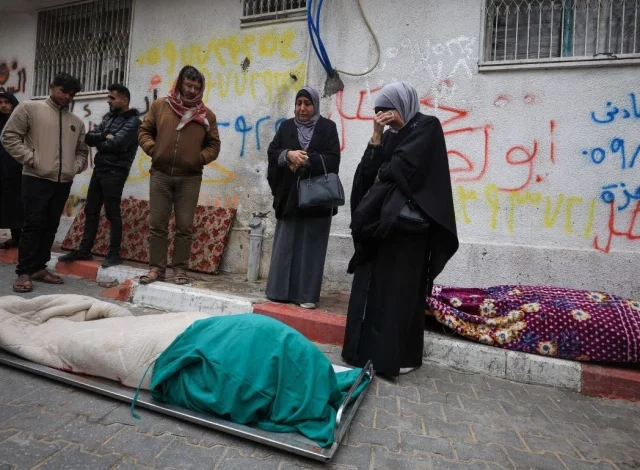
Mourners gather next to bodies as they attend the funeral of Palestinians who, according to medics, were killed after a wall collapsed at a war-damaged building, on a windy winter day, at Al-Shifa Hospital in Gaza City, January 13, 2026. PHOTO: REUTERS
The first meeting of the Gaza Administration Committee began Friday in Cairo, Egyptian media reported.
Qahera news TV said the initial session of the Palestinian National Committee tasked with managing the Gaza Strip had convened in the Egyptian capital, focusing on relief and postwar reconstruction plans.
Local sources as well as Palestinian, regional, and international media have reported that a technocratic committee was recently formed and its Palestinian members named.
The development came after US Middle East Envoy Steve Witkoff announced the start of phase two of the US Gaza plan and the outcomes of talks among Palestinian factions held in Cairo on Wednesday, the channel reported.
Phase two centers on a Peace Council framework that combines a Palestinian technocratic committee with an international stabilization force to manage Gaza’s transition.
Read More: Israel sees spike in PTSD and suicide among troops as Gaza conflict persists
The arrangement envisions a technocratic body handling civil administration and basic services as Israeli forces withdraw from the enclave, while an international force provides security and stability on a temporary basis.
The structure would reportedly operate under the supervision of a Peace Council led by US President Donald Trump backed by a resolution adopted by the UN Security Council.
According to sources, the technocratic committee is chaired by Ali Shaath, a former Palestinian deputy planning minister.
Its known members include Omar Shamaly, responsible for telecommunications, along with Abdul Karim Ashour for agriculture, Raed Yaghi for health, Raed Abu Ramadan for trade and the economy, Jabr al-Daour for education, Bashir al-Rais for finance, Ali Barhoum for water and municipalities, and Hanaa Tarzi for social affairs and women’s issues.
Source link