The Ultimate Guide to UK Spring Wildflowers: Identification, Folklore, and Walks

There is a moment every year—usually sometime in January to February—when the grey curtain of winter begins to twitch.
It starts not with warmth, but with light. The days stretch out a little longer, the birdsong changes pitch, and down in the cold earth, something incredible is waking up.
The British spring doesn’t arrive all at once. It is a slow, moving wave of green that travels northwards at about 20 miles a day, painting the woodlands, hedgerows, and meadows in a sequence of colours that has remained unchanged for thousands of years.

At Baldhiker, we spend our lives walking through these landscapes. We know that a walk is never just a walk—it’s a chance to connect with the living history at your feet.
Whether you are trekking through the ancient woodlands of West Sussex or strolling the lanes of the Lake District, knowing what you are looking at turns a hike into a discovery.
This guide is your roadmap to the British spring. We’ve broken it down by the “waves” of the season, helping you identify what’s blooming right now, with links to our deep-dive guides on identifying each species, their fascinating folklore, and where to find them.
Phase 1: The Early Risers (January – March)

These are the brave souls. The ground is often frozen, and snow is still a real possibility, but these flowers have evolved to snatch the early light before the trees overhead block it out.
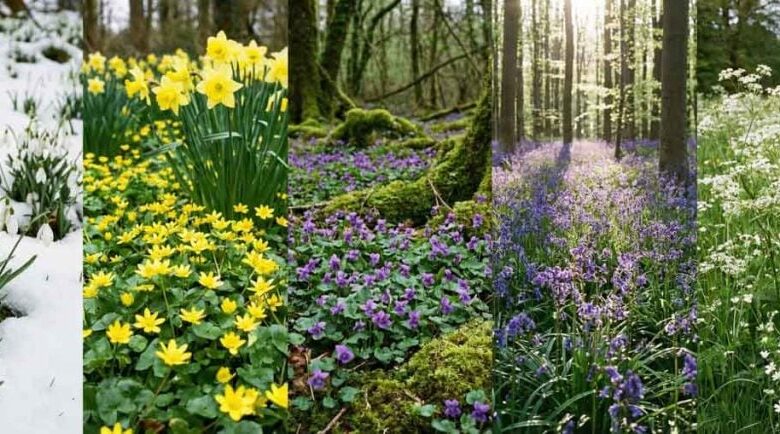
The Snowdrop (Galanthus)

The undisputed starting gun of the season. Did you know they have a biological “antifreeze” in their cells to stop them freezing solid?
The Crocus

While the Snowdrop brings the white, the Crocus brings the colour. From the purple of the mountains to the yellow of the garden, these tough little gems are a lifeline for early bees.
Lesser Celandine (Ficaria verna)

Often overlooked, this is actually the true “poet’s flower.” William Wordsworth loved this golden, star-shaped bloom even more than the daffodil. It carpets damp woodland paths with heart-shaped leaves and glossy yellow petals.
Phase 2: The Ancient Woodland Indicators (March – April)

This is the most magical time to be in a British wood. As the sun warms the soil, the “Ancient Woodland Indicators” appear.
These are plants that spread so slowly (often via creeping roots rather than seeds) that a carpet of them suggests the wood has been there for centuries.
The Daffodil (Narcissus)

Forget the shop-bought bunches. Seeing the native Wild Daffodil—smaller, paler, and more delicate—nodding in the wind is a completely different experience.
Wood Anemone (Anemone nemorosa)

The “Windflower.” These delicate white stars hang their heads in the rain and follow the sun during the day.
If you see thousands of these, you are standing on history—they spread at a rate of just six feet every hundred years.
Primrose (Primula vulgaris)

The “First Rose” of the year. With its pale, custard-yellow petals and crinkled leaves, it is perhaps the most quintessentially British flower of the hedgerow.
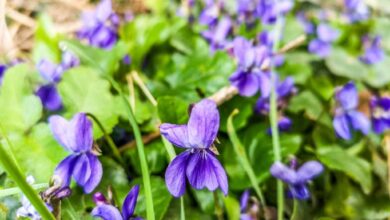
Common Dog Violet (Viola riviniana)

Don’t let the lack of scent fool you. This little purple gem is an ecological superhero, serving as the sole food source for the caterpillars of some of our rarest Fritillary butterflies.
Phase 3: The Bluebell Peak (April – May)

This is the big one. The UK is home to up to half of the world’s population of Bluebells. The spectacle of a bluebell wood in full bloom is something that happens almost nowhere else on earth.
Bluebells (Hyacinthoides non-scripta)

The native British Bluebell is distinct from the invasive Spanish variety—it is deeply scented, droops to one side, and has creamy white pollen.
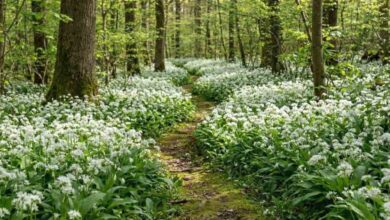
Wild Garlic / Ramsons (Allium ursinum)

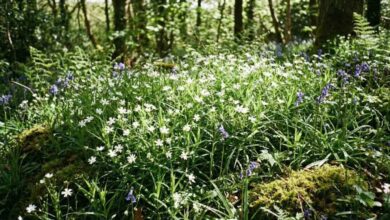
You usually smell them before you see them! Known as “Bear’s Garlic,” they carpet the floor in white stars.
They are delicious, but you must know how to identify them safely to avoid toxic lookalikes like Lily of the Valley.
Phase 4: The Transition to Summer (May – June)

As the canopy closes over the woods, the action shifts to the open meadows, hedgerows, and the coast. The flowers get taller, competing with the growing grasses.
Cow Parsley (Anthriscus sylvestris)

The frothy white “Queen Anne’s Lace” that lines every country lane in May. It signifies that summer is just around the corner.
Greater Stitchwort (Stellaria holostea)

Also known as “Poppers” or “Daddy’s Shirt Buttons.” Listen closely on a warm day, and you might hear their seed pods exploding with a snap!
Sea Thrift (Armeria maritima)

If you are walking the coastal paths, look for these pink, pom-pom flowers nodding in the sea breeze. They are tough, salt-tolerant, and incredibly pretty.
Looking Ahead: The Flowers of Summer
As the fresh greens of spring darken into summer, a new cast of characters arrives. Keep your eyes peeled for the vibrant orange of Fox and Cubs and the bright, cheerful faces of the The Pretty and Everlasting Daisy Flower
Get Out There
The British spring is fleeting. The Wood Anemones will only be here for a few weeks before the trees leaf out and plunge them into shade. The Bluebells will peak and fade in the blink of an eye.

So grab your boots, check our Hiking Guides, and get out there. And when you spot that flash of yellow or purple, you’ll know exactly who you are looking at.
Source link