As we move from the gentle awakening of April into the lush abundance of May and June, the British countryside undergoes a wardrobe change.
The woodland floors, once blue with Bluebells, darken as the canopy closes. The action shifts to the edges—to the roadside verges and the hedgerows.
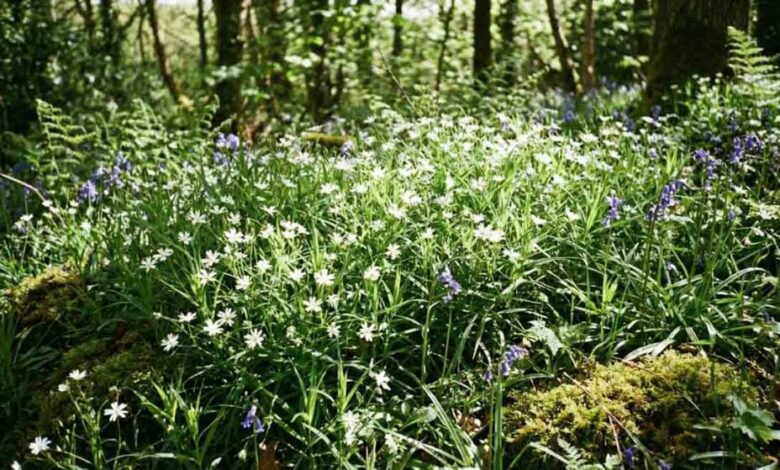
If you drive or walk down a country lane in late Spring, you’ll see it. That frothy, chaotic explosion of white stars scrambling over the nettles and tangled grasses. This is the Greater Stitchwort (Stellaria holostea).
It’s a flower I have always had a soft spot for. It feels like the confetti of late spring. But it isn’t just a pretty face; this plant has a noisy secret, a taste for “human” ailments, and a reputation for causing thunderstorms.

The Flower That Goes “Pop”
You might know this flower by one of its many delightful local names: Popguns, Poppers, or Snapjacks.
These names aren’t just charming; they are descriptive. As the white flowers fade in early summer, they are replaced by small, round seed capsules.
When these ripen in the warm sun, the tension builds up inside until—snap!—the capsule explodes, launching the seeds away from the parent plant.
If you sit quietly by a hedgerow on a hot June afternoon, you can actually hear them popping. It’s a tiny artillery barrage happening right in the undergrowth.
Even the stems are brittle. If you try to pick them (though you shouldn’t—more on that in a moment), the square stems tend to snap easily, leading to another old nickname: Snapdragon (not to be confused with the garden flower of the same name).
5 Petals or 10?
Here is a quick challenge for your next walk. When you find a Greater Stitchwort, lean in close and count the petals.

At first glance, you will swear there are ten petals. But look closer. There are actually only five. Each petal is split so deeply down the middle (bifurcated) that it looks like two separate plumes.
It’s a simple optical illusion that gives the flower its delicate, star-like quality—hence another nickname, Star-of-Bethlehem.
A Cure for the “Stitch”
Why “Stitchwort”? It sounds like something from a Harry Potter potion class.
The “wort” part is Old English for plant/herb, and “stitch” refers exactly to what you think it does. In the days of medieval herbalism, it was believed that this plant could cure that sharp pain in your side you get after running—a stitch.
It likely got this reputation because the leaves are grass-like and paired on the stem, resembling the stitching on a piece of clothing. Under the “Doctrine of Signatures” (the belief that a plant looks like the thing it cures), herbalists assumed it must be good for mending a “stitch” in the body.
I wouldn’t recommend trying it halfway through your next marathon, though. I think I’ll stick to deep breathing and slowing down!
Don’t Upset the Pixies
Now, a word of warning for those hiking in the West Country. In Cornwall, this flower is often associated with the Pixies (or Piskies).
Folklore claims that the Greater Stitchwort belongs to them. If you pick the flowers, you risk being “pixie-led”—which is a charming way of saying you’ll get hopelessly lost, even on a path you know well.
In other parts of the country, the superstition is even more dramatic. Picking the flowers was said to summon a thunderstorm.
This gave rise to the ominous nickname Thunderbolts. So, if you are out on an exposed ridge and the sky looks dark, maybe leave the Stitchwort alone, just in case.
The Salad of the Woods
If you are brave enough to risk the wrath of the pixies, Greater Stitchwort is actually a fantastic wild edible.

It is one of the most palatable wild greens you can find. I often nibble a piece as I walk (always identify 100% before eating!). It has a crisp texture, not unlike lettuce, with a fresh, grassy flavour that tastes like the essence of spring.
The flowers look beautiful scattered over a salad, and because they appear just as the BBQ season is starting, they make a great garnish for outdoor feasts.
It’s colloquially known as “Poor Man’s Buttonhole” or “Daddy’s Shirt Buttons,” but to foragers, it’s simply a delicious, abundant snack.
A Sign of Summer
For me, the Greater Stitchwort marks the bridge between the seasons. When it arrives, the frost is usually behind us. The swallows are back, the days are stretching out, and the hedgerows are buzzing with life.
So next time you pass that tangle of white stars on the lane, stop for a second. Count the petals. Nibble a leaf. And if it’s a warm afternoon, listen carefully. You might just hear the sound of the British summer popping into existence.
Source link