When we think of violets, we usually think of perfume. We think of Victorian posies, sweet-smelling soaps, and that distinct, heady scent that signals spring has arrived.
But if you are walking through a British wood in April or May and you spot a carpet of purple flowers, you might find yourself kneeling down for a sniff and smelling… absolutely nothing.
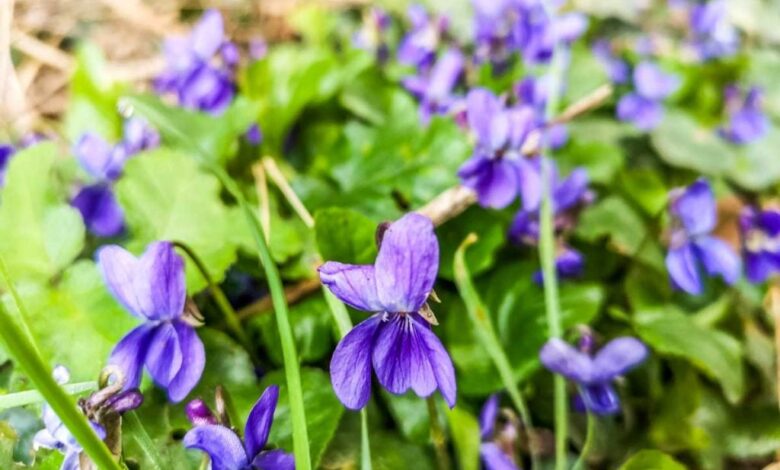
Don’t be disappointed. You haven’t lost your sense of smell, and you haven’t found a “broken” flower. You have likely found the Common Dog Violet (Viola riviniana).
It might lack the famous fragrance of its cousin, the Sweet Violet, but this little flower is, in my opinion, the unsung hero of our woodlands.
It is a survivor, a shapeshifter, and for some of our most beautiful butterflies, it is the difference between life and death.

Why “Dog” Violet?
Let’s address the rather unromantic name first. Why “Dog”?
It has nothing to do with our four-legged friends. In old English botanical language, the prefix “dog” was often used to mean “false” or “inferior.”
Because this violet didn’t have the sweet scent of Viola odorata (Sweet Violet), herbalists and country folk considered it the “inferior” version.
I think that’s a bit harsh. It might be scentless, but it is visually stunning. The flowers are a vibrant blue-purple, standing proud on their stems rather than hiding shyly in the leaves like the Sweet Violet often does.

How to Spot It (The “Spur” Test)
Violets can be tricky to tell apart, but there is a secret handshake to identifying them. You have to look behind the flower.
Protruding from the back of the petals is a little tube called a “spur.”
- Sweet Violet: The spur is usually purple or dark.
- Common Dog Violet: The spur is pale (creamy or white) and—here is the key—it has a little notch at the tip.

If you have a magnifying glass (or good eyesight), check the green sepals (the leaf-like bits clasping the flower petals). On the Dog Violet, they are pointed. On the Sweet Violet, they are blunt.
The Butterfly Lifeline
While we might pass it by because it doesn’t smell, the insect world knows exactly where it is.
The Common Dog Violet is the critical food plant for the caterpillars of some of our most striking and threatened butterflies: the Silver-washed Fritillary, the Pearl-bordered Fritillary, and the Dark Green Fritillary.

These butterflies are fussy eaters. They lay their eggs on or near the violets. When the caterpillars hatch, they rely entirely on these leaves to fuel their transformation.
If you are lucky enough to see a Silver-washed Fritillary gliding through a sunny glade in high summer, remember: it wouldn’t be there without this humble, scentless little flower.
Ballistic Seeds and Helpful Ants
This plant has a fascinating way of getting around. As the seed pods dry out in summer, they contract and squeeze the seeds until—pop!—they are launched ballistically away from the parent plant.
But the journey doesn’t end there. The seeds have a small, fatty appendage attached to them called an elaiosome. This is essentially an ant snack.
Ants love this fatty treat, so they pick up the seeds and carry them back to their nests. They eat the fatty bit and discard the seed, effectively planting it in a new location, underground, safe from birds.
It’s a perfect partnership. The ants get dinner, and the violet gets a free taxi ride to a new home.

Folklore and Foraging
There is a quirky bit of folklore surrounding this plant involving children’s teeth. It was once believed that if a child swallowed a milk tooth, they had to eat a Dog Violet petal immediately.
If they didn’t, the superstition said their new adult tooth would grow in shaped like a dog’s fang!
On a more practical note, like all violets, the flowers are edible. They look beautiful scattered over a spring salad, adding a splash of colour to the greenery.
Just be 100% sure of your identification—while the Dog Violet is safe (the leaves are edible too, high in vitamins A and C), you don’t want to mix it up with anything else on the forest floor.
A Jewel in the Grass
Next time you are out hiking and you see those flashes of purple on the bank, take a moment to look closer. Check the spur. See if it’s pale and notched.
If it is, give a little nod of respect to the Common Dog Violet. It might not smell like a perfume shop, but it’s feeding the ants, raising the butterflies, and brightening up the British spring in its own quiet, resilient way.
Source link