Lessons from global megacities show data-driven transport and air-quality reforms can reverse trend
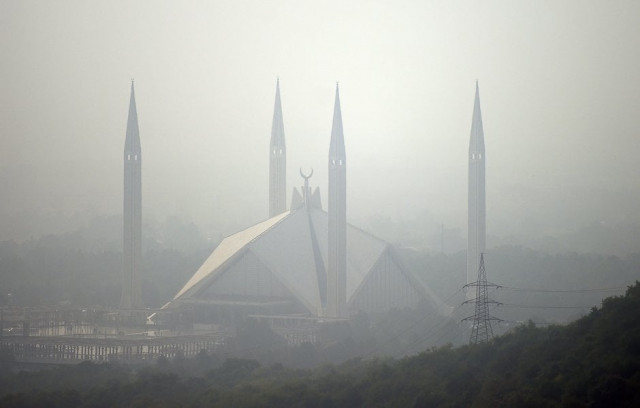
The grand Faisal Mosque is seen covered in heavy smog in Islamabad. PHOTO: AFP
ISLAMABAD:
Islamabad, once known as a city of parks and gardens, is now confronting a full-fledged smog season. Skies have turned grey-brown, and the air often tastes metallic before noon. With the Air Quality Index (AQI) exceeding the 200 mark, citizens are reporting a sharp rise in eye infections, throat pain, and nasal and skin allergies.
Contrary to the popular narrative that blames cross-border pollution, recent reports show that air pollution in Islamabad and Rawalpindi is largely locally driven. Transportation accounts for 53% of emissions, with over a million vehicles registered in Islamabad over the past decade alone.
Research indicates that tyre and brake wear generate substantial PM2.5 particles — tiny fragments of rubber, metal, and synthetic materials that become airborne with every acceleration and braking cycle. The problem worsens during winter, when cold temperatures trap pollutants close to the ground. With little wind or rain to disperse them, a dense brown haze settles over urban areas. The surrounding Margalla Hills act as a physical barrier, effectively trapping this layer of total suspended particles to form persistent smog.
Although the Islamabad Capital Territory (ICT) administration has begun cracking down on smoke-emitting vehicles, but what we need right now is to discourage the use of private vehicles where possible. For example, a short car journey to drop children at school (instead of using school bus) might seem harmless, but if we multiply this by thousands of families, then the cumulative effect creates pollution hotspots precisely in these educational institutions.
Outside elite schools in sectors F-6, F-7, and F-8, morning traffic jams represent more than congestion. Residents frequently report irritability, difficulty concentrating, and a sense of heaviness on high-pollution days, along with a claustrophobic feeling when visibility drops. Pollution is not merely shortening lives by a few years; it is also eroding daily productivity and creating an economic crisis in disguise.
Islamabad also faces a uniquely dangerous challenge. The city has earned the reputation of being the “allergy capital of the world,” with pollen counts reaching 45,000 grains per cubic metre in spring. When winter smog transitions into pollen season, residents endure a devastating one-two punch. Airways damaged by months of PM2.5 exposure become hypersensitive to the massive pollen influx.
It is imperative that Islamabad draw lessons from megacities such as Beijing, New York, and Jakarta to develop a credible policy roadmap. These cities adopted a mix of public awareness campaigns and extensive data collection. Beijing reduced PM2.5 levels by over 50% within a decade through systematic, evidence-based interventions, while New York achieved similar success through sustained commitment to clean air policies.
Building on these lessons, Islamabad should pursue a multi-pronged strategy grounded in data and evidence. For instance, we should install air quality monitoring equipment in every neighbourhood, with real-time data made accessible through public dashboards. When residents can see pollution and pollen levels in their immediate surroundings, behavioural change becomes possible. These dashboards could also estimate the years of life expectancy lost to pollution and generate alerts for vulnerable groups, including children, the elderly, and those with asthma.
Instead of rolling out untested blanket policies, the city could conduct controlled experiments across comparable neighbourhoods. One sector could pilot green transport corridors, while another enforces stricter vehicle emission controls. Certain roads could be closed to private cars during early morning hours, allowing only mass transit and school buses.
This “parallel earths” approach would reveal which interventions deliver the greatest health and air-quality benefits in Islamabad’s specific context. Any greening initiatives must also consider allergenic potential; replacing paper mulberry trees with low-allergen species could reduce pollen loads while improving air quality.
Since pollution peaks during winter, we need to develop winter emergency response systems similar to heatwave protocols. During high pollution episodes, temporary vehicle restrictions, construction moratoriums, and enhanced public transport services should be enforced.
Pakistan experienced unusually clean air during the 2020 pandemic lockdown, and periodic “clean air days” with targeted vehicle restrictions could replicate those benefits without inflicting economic damage.
Islamabad’s smog crisis may feel overwhelming, but cities around the world have shown that dramatic improvement is achievable. The real question is not whether Islamabad can solve its smog problem, but whether it can summon the political will and sustained commitment required to do so.
THE WRITER IS A CAMBRIDGE GRADUATE AND WORKS AS A STRATEGY CONSULTANT
Source link