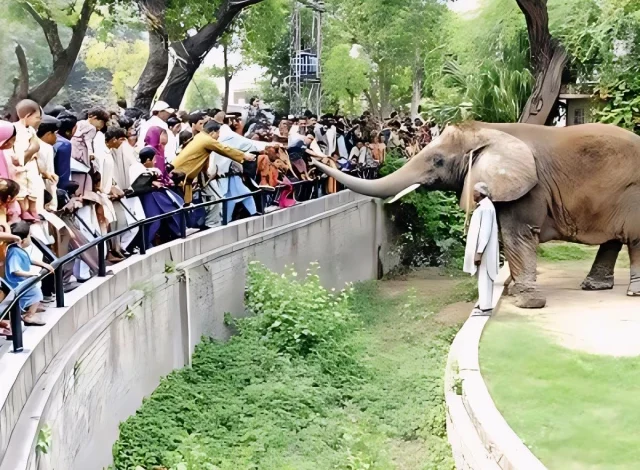
oo Director Asim Cheema explained that Lahore Zoo was once the city’s main recreation spot, but now there were many alternatives such as the Safari Park and other leisure destinations. PHOTO: ET
LAHORE:
Punjab’s historic Lahore Zoo, which cost nearly Rs2 billion for its upgradation, has failed to attract public interest. Experts conclude that the zoo’s upgradation, once touted as a model for modern urban recreation in Pakistan, has lost public appeal due to fewer animals, high costs, and an artificial environment.
Launched in November 2023, by then caretaker Chief Minister Mohsin Naqvi, the upgrade plan aimed to modernize the Lahore Zoo to international standards, improve animal habitats, and introduce exotic species. Announcements were made to bring in pandas, elephants, rhinos, hippos, and giraffes, but so far, only three giraffes and a few species of antelopes, such as nyala, gemsbok, Arabian oryx, and patas monkeys, have been introduced.
The project was supposed to be completed by January 2024, but delays pushed its partial reopening to June 2024, coinciding with Eid al-Adha. On this occasion, several new attractions were introduced, including a fish aquarium, reptile house, walk-through aviary, mixed reality, virtual reality, and Holoverse experiences. Separate tickets were set for each facility, with prices ranging from Rs100 and Rs300.
On January 1, 2025, the zoo’s entry, parking, and ticketing system was handed over to a private company, which obtained the contract for Rs500 million annually. It was anticipated that around 2.8 million visitors would come each year, and if the number exceeded projections, the zoo administration would receive 10 per cent of the additional ticket revenue.
Unfortunately, however, things did not go as expected. The company made it mandatory for visitors to purchase additional attraction tickets with entry, leading to strong public backlash. After receiving warnings from the Wildlife Department, the company terminated the contract on July 16, 2025, and the next day, the zoo administration took over operations again.
Statistics show that in the first ten months of 2023, 2.3 million people visited the zoo. After the upgrade, between June and December 2024, 1.7 million visitors came, mostly out of curiosity to see the new facilities. Under private management, from January to July 16, 2025,, only 728,000 people visited, while from July 17 to October 19, 2025, 434,181 visitors showed up. After the administration reduced ticket prices for the new attractions, visits gradually began to improve.
According to zoo sources, the initial crowd was driven by curiosity, but over time, public interest declined because the animals promised were never brought in. A visitor, Fayyaz Ahmed, revealed that his children used to love seeing the elephant, but now they were disappointed to see an empty space. Another visitor, Shagufta Riaz, who came with her children, complained that each facility required a separate ticket, making the visit too expensive.
“Despite the upgrades, interest in Lahore Zoo has declined due to several factors. The imported species are not popular locally, and the number of lions, deer, and chimpanzees has dropped. Some enclosures have only three to four animals, most of which stay hidden in shelters. Expensive digital features like Holoverse cause boredom rather than excitement. The heavy focus on construction has destroyed the zoo’s natural appeal,” commented Ashfaq Khan, a tour operator.
Conversely, Zoo Director Asim Cheema explained that Lahore Zoo was once the city’s main recreation spot, but now there were many alternatives such as the Safari Park and other leisure destinations. “Ticket prices for additional facilities have been reduced, and visitor numbers have started to improve in recent months,” claimed Cheema.
Former Deputy Director of Punjab Wildlife, Azhar Khalid, criticized the upgradation, claiming that the zoo had been turned into concrete in the name of development. “Animals and birds need a friendly, natural environment, and the more the zoo harmonizes with nature, the more attractive and beneficial it becomes for both visitors and wildlife,” opined Khalid.
Source link